
Keeping on top of the house can feel like a never-ending job when you are juggling work, children, meals, school runs and everything else family life throws at you. You can spend an hour cleaning the kitchen, only for somebody to make a sandwich five minutes later and somehow leave crumbs across every available surface.
Over the years, I have realised that the secret isn’t trying to keep the whole house perfectly clean all of the time. For a busy family, that simply isn’t realistic. What works much better is having a flexible cleaning schedule that breaks household jobs into manageable tasks and helps prevent everything from building up at once.
A good cleaning routine shouldn’t leave you feeling as though you’ve failed because you missed Tuesday’s bathroom clean. It should make life easier. Some weeks you might manage everything on your list; other weeks, simply keeping on top of the washing, dishes and most-used rooms is an achievement.
Editor’s Note: This article was originally published in October 2019 and has been extensively updated in September 2026 to include a more practical weekly cleaning schedule, realistic routines for busy families, age-appropriate ways for children to help and additional tips for keeping on top of housework when life gets busy.
In this guide, I’ll show you how to create a realistic cleaning schedule for a busy family, including simple daily habits, a manageable weekly routine and ways to get everyone in the household involved.
That said, plenty of ways exist to create a cleaning schedule that fits your hectic lifestyle. Here are five tips that help you have the clean house you want and deserve:
Start by deciding what actually needs cleaning

Before creating a cleaning schedule, it helps to forget about the idea that every room needs the same amount of attention. In a busy family home, some jobs need doing every day, while others can comfortably wait a week – or even longer.
Start by walking through your home and making a quick list of the jobs that regularly need your attention. You can then divide them into daily, weekly and occasional tasks.
For example:
Daily cleaning tasks might include:
- Loading and unloading the dishwasher
- Wiping kitchen worktops
- Clearing obvious clutter
- Sweeping or vacuuming high-traffic areas
- Wiping the dining table
- Doing a quick kitchen reset after dinner
Weekly cleaning tasks might include:
- Cleaning bathrooms
- Vacuuming throughout the house
- Mopping hard floors
- Dusting surfaces
- Changing bed linen
- Emptying bins
- Cleaning mirrors
Occasional cleaning tasks might include:
- Cleaning windows
- Wiping skirting boards
- Cleaning behind furniture
- Washing curtains or cleaning blinds
- Deep-cleaning the oven
- Sorting cupboards and drawers
Once you see everything written down, it becomes much easier to spread those jobs across the week rather than trying to tackle the entire house in one exhausting cleaning session.
Forget the idea of a perfect cleaning routine
This is probably the most important part of creating a cleaning schedule that you’ll actually stick to: leave room for real life.
There will be weeks when work is hectic, the children have activities every evening, someone is poorly, or you simply don’t have the energy to clean the bathroom because a spreadsheet says it’s Tuesday.
That’s fine.
I find it much more helpful to think of a cleaning schedule as a guide rather than a strict timetable. If something doesn’t get done today, move it to another day or decide whether it really needs doing that week at all.
The aim isn’t to have a show-home-perfect house. It’s to create a home that feels clean, comfortable and manageable without spending all of your free time cleaning it.
Sometimes, even the best schedules are not enough to keep up with the daily mess. When work and family life become too busy, outsourcing some of the work is a practical option. Hiring a professional house cleaner in melbourne can give you your weekends back. This allows you to focus on your family instead of worrying about dusty shelves or dirty floors. It is a simple way to keep your home tidy without adding more stress to your weekly routine.
Create a realistic weekly cleaning schedule
Once you’ve decided which jobs need doing regularly, you can start spreading them across the week. I prefer this approach because it means there isn’t one enormous cleaning day looming over me at the weekend.
The key is not to overload each day. Choose one main area or a handful of related jobs and fit them around what is already happening in your family.
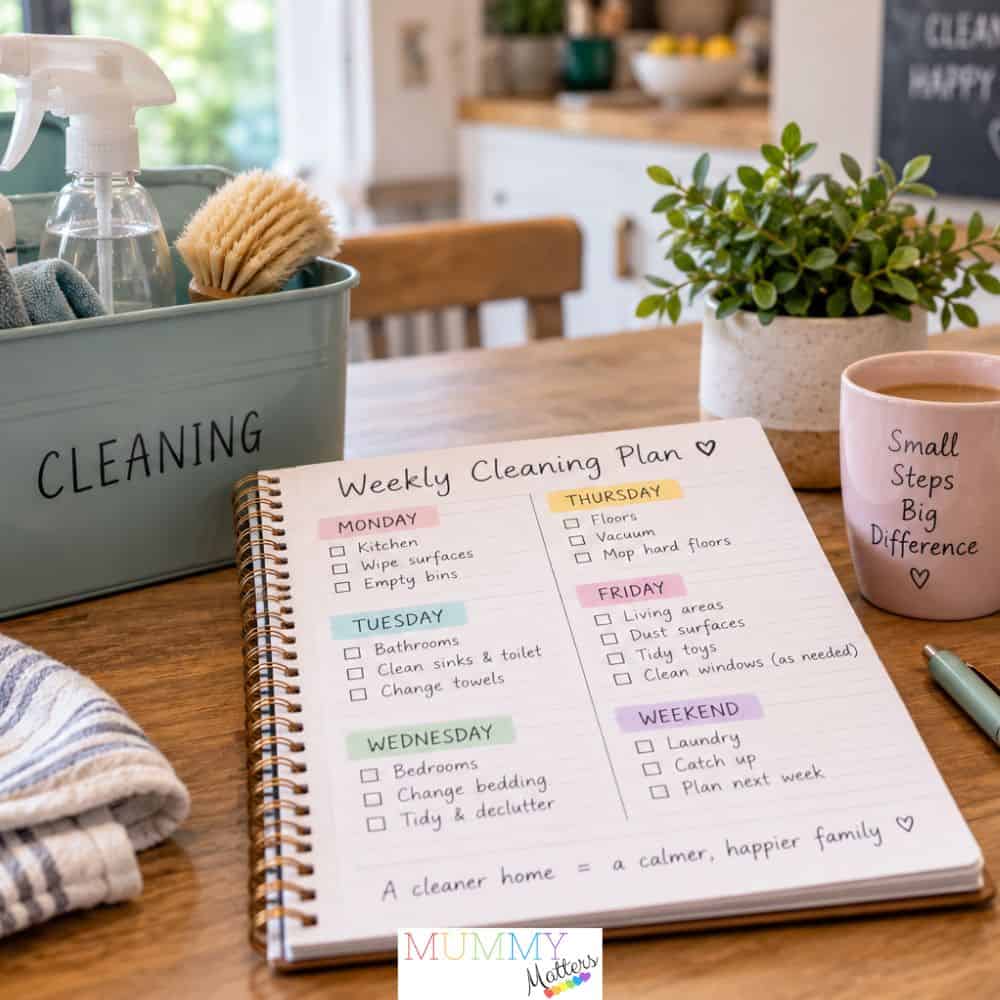
Here is a simple weekly cleaning schedule you could use as a starting point:
| Day | Main focus | Jobs to tackle |
|---|---|---|
| Monday | Kitchen | Wipe cupboard fronts, clean the hob and appliances, check the fridge and mop the floor |
| Tuesday | Bathrooms | Clean toilets, sinks, baths and showers, wipe mirrors and change towels |
| Wednesday | Bedrooms | Change bed linen, dust surfaces, empty bins and vacuum |
| Thursday | Living areas | Dust, tidy surfaces, vacuum sofas and floors and deal with clutter |
| Friday | Floors | Vacuum high-traffic areas and mop hard floors |
| Saturday | Catch-up jobs | Finish anything missed during the week or tackle one occasional cleaning job |
| Sunday | Quick reset | Put things back where they belong and prepare the house for the week ahead |
Keep the daily cleaning routine simple

Alongside your main job for the day, it helps to have a few small tasks that keep the house ticking over. These don’t need to become an enormous daily checklist.
For me, the basics are things such as keeping on top of the dishwasher, wiping the kitchen surfaces, dealing with washing and encouraging everyone to put away the things they’ve used.
You might choose three or four daily non-negotiables, such as:
- Make the beds
- Load or empty the dishwasher
- Wipe kitchen worktops
- Put away obvious clutter
- Do one load of laundry when needed
- Give high-traffic floors a quick vacuum
The important thing is to choose tasks that make the biggest difference to how your home feels.
Adapt the schedule to suit your family
There is no universal cleaning schedule that will work for every household. A family with toddlers and pets will probably need to vacuum more often than someone living alone, while a household with several teenagers may generate considerably more washing than you ever thought humanly possible!
Your working pattern matters too. If Tuesdays are packed with after-school activities, don’t make Tuesday your biggest cleaning day. If you work from home on a Friday, perhaps that’s a better opportunity to change beds or get through several loads of washing.
Think of the schedule above as a template rather than a set of rules. Move jobs around, combine tasks or skip things that don’t need doing that week.
A useful cleaning schedule is one that fits around your life – not one that makes you rearrange your life around the cleaning.
Use 10-minute cleaning sessions on busy days

One of the easiest ways to keep a cleaning schedule manageable is to stop assuming that cleaning needs to take hours. You can get a surprising amount done in ten or fifteen minutes, particularly if you concentrate on one room or one type of task.
On busy days, I would much rather do a quick ten-minute reset than wait until I have enough time to clean the entire house – because realistically, that large block of spare time rarely appears.
Set a timer for ten minutes and choose one area to tackle. You might:
- Clear and wipe the kitchen worktops
- Load the dishwasher and clean the sink
- Vacuum the downstairs floors
- Wipe the bathroom sink, toilet and mirror
- Put away a basket of clean laundry
- Clear clutter from the living room
- Tidy shoes, coats and bags around the hallway
When the timer finishes, you can stop. If you’re on a roll and have more time, carry on, but don’t make that the expectation.
If clutter is one of the things making your home feel overwhelming, I’ve also shared some simple ways to create a calm home rhythm using realistic routines rather than striving for perfection.
Clean as you go where it makes sense
Some cleaning jobs are also much easier when you attach them to something you’re already doing.
For example, wipe the bathroom sink after brushing your teeth, clean the kitchen worktops while you’re waiting for the kettle to boil or put a few things away while dinner is cooking.
I also find the kitchen much nicer to walk into in the morning if we’ve dealt with the dishes and wiped the worktops the night before. It doesn’t need to be spotless; I just don’t want to start a new day surrounded by yesterday’s mess.
These tiny habits might only save a few minutes each time, but collectively they prevent lots of small jobs from turning into one enormous cleaning session at the end of the week.
Use your timer on the days when you really don’t feel like cleaning
The timer trick can be particularly useful when the house feels overwhelming. Instead of looking around and thinking, I need to clean all of this, give yourself permission to do ten minutes.
Start with whatever will make the biggest visual difference – perhaps clearing the kitchen island, putting the living room back together or getting everything off the floor.
You may be surprised by how different the room feels after just ten focused minutes. And if ten minutes is all you have the time or energy for that day, that’s still ten minutes of cleaning you don’t need to do later.
Make regular cleaning as easy as possible
The easier a cleaning job is to start, the more likely you are to actually do it. If getting the vacuum cleaner out involves moving three boxes, untangling a cable and hunting for the right attachment, a quick five-minute clean suddenly feels like much more effort.
Where possible, keep the cleaning products and tools you use regularly somewhere convenient and easy to reach. A lightweight or cordless vacuum can be particularly useful for quickly dealing with crumbs, pet hair and the everyday debris that seems to appear constantly in a family home.
The same applies to other cleaning jobs. Keep microfibre cloths where you use them, have a laundry basket somewhere clothes naturally accumulate and make sure everyone knows where things belong. If you have younger children at home, remember to keep cleaning products safely stored out of their reach.
Focus on high-traffic areas first
You don’t necessarily need to vacuum every room every day. Concentrate on the areas that become dirty fastest, such as the kitchen, hallway and living room, and leave bedrooms or less-used spaces for your weekly clean.
This is another reason a flexible cleaning schedule works better than trying to clean the entire house every time you get the vacuum out.
On particularly busy days, I concentrate on the areas we can actually see and use the most. Getting crumbs off the kitchen floor or quickly vacuuming the living room can make the whole house feel cleaner, even if the bedrooms have to wait until another day.
Let useful cleaning tools save you time
I’m all for anything that makes an everyday household job quicker. If you have tools that can tackle more than one task, make the most of them rather than making cleaning more complicated than it needs to be.
For example, a multi-surface floor cleaner can save time when you’re dealing with the inevitable spills, crumbs and muddy footprints of family life. The goal isn’t to own a cupboard full of cleaning gadgets; it’s to find the few things that genuinely make maintaining your home easier.
Get the whole family involved

A family cleaning schedule shouldn’t mean that one person is responsible for keeping the entire house running. If you have younger children who are reluctant to help, there are plenty of ways to make tidying fun for kids rather than turning it into a battle.
What children can realistically help with will obviously depend on their age, but even younger children can start getting into the habit of putting toys away, placing dirty clothes in the laundry basket or helping to set and clear the table.
As they get older, they can take responsibility for more of their own space and belongings. Jobs might include:
- Making their bed and keeping their bedroom reasonably tidy
- Putting dirty clothes in the laundry basket
- Putting clean clothes away
- Loading or unloading the dishwasher
- Clearing and wiping the table after meals
- Vacuuming a room
- Taking rubbish or recycling out
- Helping to change their bed linen
- Putting shoes, coats and school bags away
In our house, I’ve found that it works better when everyone knows what is expected of them rather than waiting until I’m already fed up with the mess and then asking for help. It doesn’t mean everyone will suddenly become enthusiastic about cleaning, but at least the responsibility isn’t automatically falling to one person.
Give children ownership of their own spaces
Bedrooms are a good place to start. Rather than expecting children to clean them to exactly the same standard you would, give them a few clear responsibilities they can manage themselves.
For younger children, that might simply mean toys off the floor and dirty clothes in the washing basket. Teenagers can gradually take more responsibility for changing their bedding, vacuuming and keeping their belongings organised.
The aim is not only to get some help with the housework. You’re also teaching children the basic skills they’ll eventually need to look after a home of their own.
Make tidying part of the family routine
It can also help to have a short family reset rather than repeatedly asking individual people to tidy throughout the day.
Ten minutes before dinner or at the end of the evening can be enough for everyone to put away the things they’ve been using. One person might clear the living room while somebody else sorts the dishwasher or gathers up shoes and bags ready for the following morning.
When everyone tackles a small job at the same time, you can get through an impressive amount without anybody spending their entire evening cleaning.
Fit cleaning around the things you are already doing
Finding extra time for cleaning can be difficult, so instead of trying to create more hours in the day, look for opportunities to fit small jobs around things you’re already doing.
If you’re waiting for dinner to cook, you could empty the dishwasher or wipe the kitchen cupboard fronts. Fold a basket of washing while watching television, sort through a drawer while you’re waiting for somebody to get ready, or take a few things upstairs whenever you’re heading that way anyway.
These little jobs don’t feel like much individually, but they can stop your cleaning list from becoming overwhelming.
Try habit stacking
One way to make this easier is to attach a cleaning task to something you already do automatically. This is sometimes called habit stacking.
For example:
- After breakfast, load the dishwasher and wipe the kitchen worktops.
- After brushing your teeth in the evening, give the bathroom sink a quick wipe.
- When you put the kettle on, put away anything that doesn’t belong in the kitchen.
- After dinner, spend five minutes resetting the kitchen.
- Before going upstairs for bed, take anything with you that belongs upstairs.
- When you start a load of washing, put away the previous clean load.
After a while, the cleaning task becomes associated with the existing habit, which means you’re less reliant on remembering to do it later.
Don’t fill every spare minute with housework
There is an important balance here. Having a busy lifestyle doesn’t mean every five-minute gap in your day needs to become an opportunity to clean something.
Rest matters too.
The point of a cleaning schedule is to give you more control over the housework, not allow housework to take over your life. If you’ve done the important jobs for the day, give yourself permission to stop.
There will always be another load of washing, another surface that could be wiped or another cupboard that could be organised. Sometimes sitting down with a cup of tea is a perfectly productive use of ten minutes too.
What to do when your cleaning schedule falls apart
Even the best cleaning schedule will occasionally go completely out of the window. You might have a particularly busy week, someone might be ill, work might take over or you might simply decide you’d rather spend your weekend doing something with the family than cleaning the house.
The worst thing you can do is look at everything you’ve missed and decide you now need to catch up with all of it at once.
Instead, reset and start again.
Sometimes the whole household routine needs a reset rather than just the cleaning. My family routine reset has more ideas for getting meals, schedules, school preparations and everyday family life feeling organised again.
Prioritise the jobs that make the biggest difference
When the house has got away from me, I find it much easier to concentrate on the things that will make it feel manageable again rather than worrying about every job that hasn’t been done.
Start with the basics:
- Deal with dirty dishes and clear the kitchen surfaces.
- Gather up rubbish and recycling.
- Put dirty washing into laundry baskets.
- Clear obvious clutter from the main living areas.
- Vacuum the floors you use most.
- Clean the bathroom if it needs attention.
Once those things are done, the house will probably already feel considerably better.
You can then return to your normal cleaning schedule rather than spending the next few days trying to make up for everything you missed.
Don’t double up next week’s cleaning jobs
If you didn’t dust the bedrooms last Wednesday, you don’t need to dust them twice this Wednesday.
It sounds obvious, but this is where a cleaning schedule can accidentally become another source of pressure. Missed tasks don’t automatically become debts that have to be repaid.
If something genuinely needs doing, move it higher up the list. If it can comfortably wait until its next turn in your schedule, let it wait.
Use a catch-up day when you need one
This is why I like leaving Saturday relatively flexible in a weekly cleaning schedule. It gives you some breathing room if something didn’t happen during the week.
You can use that time to catch up with one or two important jobs, tackle something you’ve been putting off or simply decide that the house is good enough and enjoy your weekend.
A cleaning schedule should help you feel more organised, not guilty. If your routine regularly feels impossible to keep up with, that’s usually a sign that the schedule needs changing – not that you need to try harder.
Know when getting help with cleaning makes sense
Creating a cleaning schedule can make running a busy home much easier, but it doesn’t mean you have to do every job yourself. Sometimes the most practical solution is to get some help.
You might consider using a professional cleaner during particularly busy periods, before or after a house move, when preparing for guests, or simply because you’d rather spend your limited free time doing something else. Some families also find that having a cleaner tackle the bigger jobs gives them a much more manageable starting point for their everyday cleaning routine.
If you’re considering professional help, look for an established cleaning company that clearly explains the services it offers, the areas it covers and what you can expect. For example, Eloise’s Cleaning offers residential cleaning services as well as options such as deep cleaning and move-in or move-out cleaning.
Before booking any cleaning service, check exactly what’s included, whether you need to provide cleaning products or equipment, how pricing works and whether there are any cancellation requirements. It’s also worth checking recent customer reviews and making sure you’re comfortable with who will be coming into your home.
Getting help with cleaning isn’t a failure of your cleaning schedule. In some circumstances, outsourcing the jobs you don’t have the time or inclination to do can be exactly what makes the rest of your routine sustainable.
A cleaning schedule should make life easier
The best cleaning schedule isn’t the one with the longest checklist or the most perfectly organised routine. It’s the one you can realistically maintain alongside work, family life and everything else competing for your time.
Start small, decide which jobs matter most and spread them across the week. Use ten-minute cleaning sessions when you’re short on time, encourage everyone in the household to play their part and don’t be afraid to change your routine when it stops working for you.
Most importantly, remember that your home is there to be lived in. There will be busy weeks when the washing piles up, crumbs appear five minutes after you’ve vacuumed and Tuesday’s bathroom clean doesn’t happen until Friday. That’s family life.
A flexible cleaning schedule gives you a simple way to get things back under control without feeling as though you need to spend an entire day cleaning. And when life gets particularly hectic, sometimes doing the essentials and leaving the rest until tomorrow is more than enough.
Frequently asked questions about cleaning schedules
What is a good cleaning schedule for a busy family?
A good cleaning schedule divides household jobs into small, manageable tasks rather than saving everything for one big cleaning day. Keep on top of a few essentials each day, such as dishes, kitchen surfaces and obvious clutter, then assign bigger jobs such as bathrooms, bedrooms, dusting and floors to different days of the week. Most importantly, make the schedule fit your family’s routine rather than copying someone else’s.
What cleaning should be done every day?
You don’t need to clean your entire home every day. For most families, daily tasks might include loading and unloading the dishwasher, wiping kitchen worktops, dealing with spills and crumbs, putting away obvious clutter and keeping on top of laundry when necessary. Focus on the jobs that make the biggest difference to how your home looks and feels.
How do you keep your house clean when you work full-time?
Try breaking cleaning into short sessions throughout the week. Ten minutes before work, after dinner or in the evening can be enough to complete one small task. Sharing age-appropriate jobs between everyone in the household and concentrating on high-traffic areas can also prevent housework from becoming an enormous weekend job.
How much time should you spend cleaning each week?
There isn’t a set number of hours that every household should spend cleaning. The size of your home, number and ages of people living there, whether you have pets and your own standards will all make a difference. Rather than aiming for a particular number of hours, create a routine that keeps your home comfortable and hygienic without taking over your free time.
How do you stick to a cleaning schedule?
Make it realistic from the beginning. Avoid putting too many jobs on any one day, build in a catch-up day and treat your schedule as a guide rather than a strict set of rules. If you repeatedly find that certain jobs don’t get done, move them to a different day, reduce how often you do them or reconsider whether they really need to be part of your regular routine.