

You’ve finally reached the end of a busy day. Homework is finished, teeth are brushed, the lights are dimmed, and your child is tucked up in bed. You’re just about to enjoy a few quiet minutes to yourself when you hear a familiar voice call from upstairs.
“I’ve just remembered something…”
Perhaps it’s a worry about school. Maybe they’re asking if the doors are locked, whether the dog is alright or if you can check on a younger sibling one more time. Sometimes it’s a “bad thought” they can’t stop thinking about. Other nights, they suddenly remember something that happened hours earlier and desperately need to talk about it before they can settle.
If this sounds familiar, you’re certainly not alone.
For many families, bedtime anxiety in older children becomes one of the most challenging parts of the day. It can be confusing, frustrating and, at times, heartbreaking to watch your child become overwhelmed just when you hoped they would be winding down for sleep.

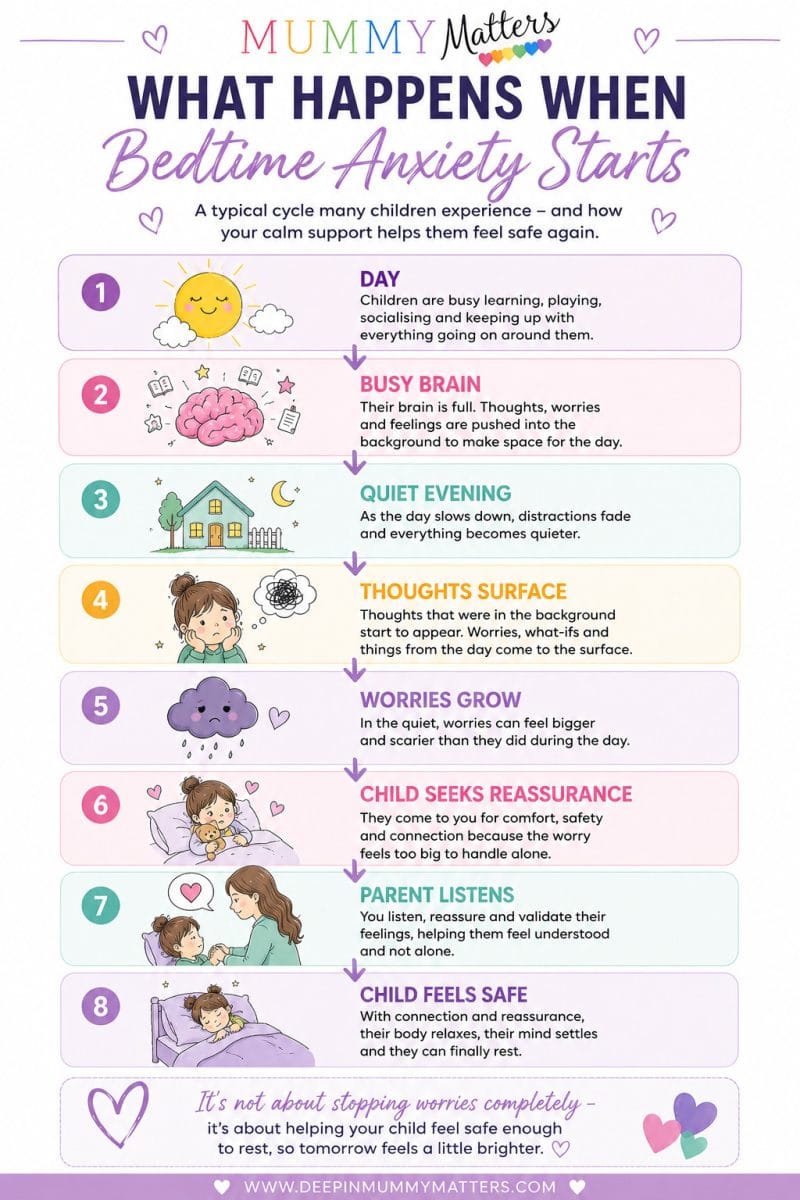
Over the years, one thing I’ve noticed is that bedtime doesn’t create these worries – it simply gives children the quiet space to hear them.
Throughout the day, children are surrounded by distractions. They’re busy learning, talking, laughing with friends, moving between lessons, spending time with family and responding to everything happening around them. By bedtime, all of that noise has faded away. For some children, that’s the first opportunity they’ve had to properly process the day’s events. Without those distractions, their thoughts suddenly become much clearer, and worries that barely registered earlier can quickly grow much bigger than they really are.
Understanding this changed the way I responded to bedtime anxiety. Instead of seeing it as another bedtime battle to solve, I began to see it as a sign that my child needed help making sense of the thoughts they’d been carrying all day.
That doesn’t mean bedtime should become an hour-long counselling session every evening. Children still need the security of a calm, predictable routine and the confidence that bedtime is a safe place to rest. The challenge is finding the balance between listening to their worries and helping them leave those worries behind until morning.
In this article, I’ll explain why bedtime anxiety often affects older children, the signs to look out for, practical strategies that have helped in our family, and when it might be time to seek extra support.
Contents showWhat Is Bedtime Anxiety in Older Children?
Bedtime anxiety is when an older child struggles to settle because worries become more noticeable once the distractions of the day disappear. Rather than simply avoiding bedtime, they may seek reassurance, replay events from school or become overwhelmed by anxious thoughts. A calm routine, opportunities to talk earlier in the evening and helping children feel heard can all make a positive difference.
What Is Bedtime Anxiety in Older Children?
Most children try to delay bedtime from time to time. They ask for another drink, one more story or an extra cuddle because they simply aren’t ready for the day to end. That’s a normal part of growing up.
Bedtime anxiety is different.
Rather than trying to stay awake for fun, an anxious child often seems genuinely unable to settle because their mind has become filled with worries. They aren’t necessarily avoiding sleep itself; they’re struggling to switch off the thoughts that arrive once everything else has gone quiet.
For some children, those worries are easy to identify. They might be anxious about school, friendships, an upcoming test or something that happened during the day. Others may worry about things that feel much bigger, such as a family member becoming ill, burglars, house fires or whether a loved one is safe.
It’s worth remembering that many worries are a normal part of childhood, although persistent anxiety that affects everyday life may need additional support. The NHS guidance on anxiety in children explains what’s considered a normal part of development and when it may be worth seeking further advice.
Sometimes they can’t explain the feeling at all.
Instead, they simply say:
“Something doesn’t feel right.”
That uncertainty can be frustrating for both children and parents. When they don’t understand why they feel anxious, they often seek reassurance from the people they trust most.
One thing I’ve learned is that children don’t always process difficult experiences in the moment. During the day, they’re busy keeping up with lessons, conversations, activities and routines. It’s only when life becomes quiet that their brain finally has the opportunity to sort through everything that’s happened.
That’s why bedtime can suddenly become the moment they remember something upsetting that happened at school, worry about an argument with a friend or replay a conversation with a teacher over and over again.
Bedtime Anxiety or Bedtime Stalling?
It isn’t always easy to tell the difference, especially because the behaviours can look very similar.
A child who is simply delaying bedtime might:
- Ask for one more story or another drink because they’re enjoying spending time with you.
- Find excuses to stay up a little longer.
- Complain that they aren’t tired.
A child experiencing bedtime anxiety is more likely to:
- Suddenly remember a worry they haven’t mentioned before.
- Ask repeated questions that seek reassurance.
- Worry about school, friendships or family members.
- Say they’ve had a “bad thought” that won’t go away.
- Become upset or tearful when it’s time to sleep.
- Keep coming back because they don’t yet feel emotionally settled.
Of course, children can experience a mixture of both. Some evenings they may genuinely be anxious, while on others they may simply be testing boundaries. As parents, we rarely get a clear sign telling us which is which.
The NHS also has some excellent practical advice through Every Mind Matters: Children’s mental health, including ways to support your child’s emotional wellbeing at home.
If you’re looking for more practical support as a parent, YoungMinds’ guide to supporting a child with anxiety offers helpful advice and information about where to get further support.
That’s why I think it’s so important to stay curious before jumping to conclusions. Listening first, asking gentle questions and looking for patterns over time often tells us much more than reacting to one difficult bedtime.
Why Worries Often Appear at Bedtime
If you’ve ever wondered why your child seems absolutely fine all day, only to become overwhelmed with worries the moment their head hits the pillow, you’re not imagining it.
It’s something many parents notice, and once you understand why it happens, bedtime can start to make a lot more sense.
Understanding what might be sitting behind your child’s bedtime worries doesn’t mean you’ll always have the answers, but it can help you respond with empathy rather than frustration. And sometimes, feeling understood is exactly what a child needs most.
During the Day, Children Are Busy Being Busy
Childhood is full of distractions.
From the moment they wake up, children are making decisions, following routines, concentrating in lessons, navigating friendships, processing conversations and responding to everything happening around them. Even when they’re playing or watching television, their brain is constantly occupied.
With so much going on, there’s often very little time to stop and properly process their thoughts or emotions.
It’s only later, when the house becomes quieter and the day begins to slow down, that those thoughts finally have room to surface.
A Quiet Mind Can Feel Like a Loud Mind

One of the biggest things I’ve noticed over the years is that bedtime doesn’t create the worries – it simply gives children the quiet space to hear them.
During the day, their thoughts are competing with conversations, lessons, games, family life and all the noise that naturally comes with being a child.
At bedtime, many of those distractions disappear.
For some children, that’s a relief.
For others, it’s when every little worry suddenly becomes much louder.
A disagreement with a friend that didn’t seem important after lunch suddenly feels enormous.
A teacher’s comment is replayed over and over again. It’s surprisingly common for children to replay conversations with teachers long after the school day has ended. If this sounds familiar, you might also find my article on what to do when your child thinks their teacher doesn’t like them helpful.
A small mistake made earlier in the day becomes something they can’t stop thinking about. If your child regularly comes home feeling they’re always in trouble or struggling to cope with being corrected, you may also find my article on Helping a Child Who Feels They’re Always Being Told Off helpful.
Or perhaps there’s no obvious reason at all. They simply know that “something doesn’t feel right”, even if they can’t explain what that feeling is.
Not Every Worry Needs Solving Before Sleep
As parents, our instinct is often to fix whatever is upsetting our child.
That’s completely understandable.
When your child is lying in bed worrying, every part of you wants to make those anxious feelings disappear.
But I’ve learned that bedtime isn’t always the best time to solve life’s biggest problems.
Children need to feel heard, but they also need permission to let those worries rest until morning. One thing I’ve learned is that children don’t necessarily expect us to fix every worry. Quite often, they’re simply looking for reassurance that they aren’t carrying it on their own.
Sometimes simply saying:
“Thank you for telling me. Let’s write that down and talk about it tomorrow when we’ve both had some sleep.”
is far more helpful than starting a long conversation that leaves everyone feeling even more anxious.
Sometimes Children Need to Empty Their Heads
Many families find it helpful to build a short “worry time” into the bedtime routine.
In our house, we set aside around ten minutes before bed to talk about anything that’s on our children’s minds. They know this is their opportunity to share worries, ask questions or tell us about something that’s been bothering them during the day.
When those ten minutes are up, the conversation finishes for the night.
That doesn’t mean their worries aren’t important.
It simply helps create a healthy boundary, teaching children that bedtime is for resting, not for carrying the weight of every anxious thought into the night.
If another worry pops into their head later, we encourage them to write it down in a notebook beside the bed so we can come back to it the next day. Often, just knowing the worry has been captured is enough to stop it going round and round in their mind.
It’s not about ignoring difficult feelings.
It’s about helping children learn that they don’t have to solve every problem before they can sleep.
What Bedtime Anxiety Can Look Like

Every child experiences bedtime differently.
Some happily climb into bed without a second thought, while others seem to find endless reasons to stay awake just a little longer. That’s completely normal.
When anxiety is part of the picture, however, the behaviour often feels different. Rather than simply trying to delay bedtime, your child may seem genuinely unsettled or unable to switch off.
Not every child will experience all of these signs, and many of them can also happen from time to time as part of typical childhood. The key is to look for patterns and consider whether worries seem to be playing a part.
“I Forgot to Tell You Something…”
If you’ve ever settled down for the evening only to hear:
“I’ve just remembered something…”
you’re certainly not alone.
It might be something that happened at school, a disagreement with a friend or a question they’ve been meaning to ask all day.
It can sometimes feel as though your child has waited until bedtime on purpose, but often that’s not the case.
Once the distractions of the day disappear, their brain finally has the chance to process everything that’s happened. Thoughts that stayed quietly in the background during the day suddenly move to the front of their mind.
Repeatedly Coming Back Downstairs
One more drink.
Another trip to the toilet.
Looking for a favourite soft toy.
Asking for an ice pack because they’re too warm.
Needing one more hug.
Sometimes these requests really are about the item they’ve asked for.
Other times, they’re a way of staying connected for just a little longer because they don’t yet feel emotionally ready to be alone with their thoughts.
Looking at the pattern over several evenings can often tell you more than focusing on a single bedtime.
Constant Reassurance
Children experiencing bedtime anxiety often look for reassurance.
You might hear questions like:
- “Have you locked the doors?”
- “Are the dogs alright?”
- “Will you still be downstairs?”
- “What if something happens tonight?”
Although these questions can become repetitive, they’re usually coming from a need to feel safe rather than a desire to be difficult.
Responding calmly while keeping reassurance brief can often be more helpful than repeatedly answering the same question in different ways.
“Something Doesn’t Feel Right”
One of the hardest things for parents is when a child can’t explain what’s wrong.
They simply know that something feels “wrong”, “bad” or “not right”.
That can leave everyone feeling frustrated because there’s no obvious problem to solve.
Sometimes children haven’t yet developed the words to describe what they’re experiencing emotionally. Other times, they genuinely don’t know why they feel anxious—they just know that they do.
Listening without putting pressure on them to find the perfect explanation can help them feel understood.
Physical Signs of Anxiety
Children don’t always express anxiety through words.
Sometimes their body speaks first.
They might complain of:
- a tummy ache
- a headache
- feeling sick
- a racing heart
- feeling hot or shaky
- finding it difficult to relax
These symptoms are very real, even when there’s no underlying physical illness.
If physical symptoms are persistent, severe or you’re concerned about your child’s health, it’s always worth seeking advice from your GP.
Night-time Waking and Nightmares
For some children, bedtime anxiety doesn’t end once they fall asleep.
Worries can continue through the night, leading to nightmares, restless sleep or waking up needing reassurance.
They may call out, come into your room or struggle to settle back to sleep because the same anxious thoughts have returned.
That can be exhausting for the whole family, particularly if it’s happening regularly.
Looking Beyond the Behaviour
One thing I’ve learned over the years is that behaviour is often a form of communication. Some children also experience particularly intense emotional reactions to criticism or perceived rejection. If that’s something you’ve noticed, you may find my article about Rejection Sensitive Dysphoria (RSD) in children useful.
When children repeatedly avoid bedtime, seek reassurance or seem unable to switch off, it’s worth gently asking yourself:
“What might my child be trying to tell me?”
Sometimes the answer is straightforward.
Other times, it takes patience, listening and a little detective work.
Either way, understanding the feeling behind the behaviour is often the first step towards helping your child feel calmer and more secure.
Looking beyond behaviour rather than reacting to it has transformed the way I parent. I explore this further in What to Do When Your Child Is Not Listening (Without Losing Your Temper).
What Genuinely Helped in Our Family

Every child is different, and there isn’t a single solution that works for everyone. What helped one of my children may not be the answer for yours, but over the years we’ve found a number of simple strategies that have made bedtime feel calmer and less overwhelming.
Rather than trying to stop the worries altogether, our focus has been on helping our children feel heard while gently teaching them that they don’t have to solve every problem before they go to sleep.
Keep Bedtime Predictable
One of the biggest differences we noticed came from having a consistent bedtime routine.
Children don’t just benefit from knowing what time they’re going to bed; they also find comfort in knowing what happens next.
Whether it’s putting on pyjamas, brushing teeth, reading together or listening to calming music, following the same routine each evening creates a sense of security. It sends the message that bedtime is familiar, safe and nothing to fear.
Life doesn’t always allow for a perfect routine, but aiming for consistency most nights can make a real difference.
Create a 10-Minute Worry Chat
This is probably the strategy that has helped us the most.
Rather than allowing worries to spill over once everyone is trying to settle for the night, we intentionally make space for them before bedtime.
We set a timer for ten minutes and make it clear that this is their opportunity to talk about anything that’s on their mind. School, friendships, embarrassing moments, fears, questions or anything else that’s been bothering them.
During those ten minutes, we listen.
We don’t rush to solve every problem or convince them they’re worrying unnecessarily. We simply let them know they’ve been heard.
When the timer finishes, the conversation finishes too.
That doesn’t mean the worries aren’t important. It means we’re gently teaching that bedtime isn’t the time to carry every fear into the night. If something still needs talking about, we’ll come back to it the following day when everyone is rested and thinking more clearly.
Children often find comfort in knowing their worries haven’t been dismissed—they’ve simply been postponed until a better time.
Write Tomorrow’s Worries Down
Some worries are too important to ignore but don’t need an answer immediately.
Keeping a notebook beside the bed gives children somewhere to “park” those thoughts.
If something pops into their head after lights out, encourage them to write it down or, if they’re younger, ask you to make a note of it.
Knowing the worry has been captured can make it much easier to let it go until morning.
More often than not, you’ll find that by the next day it doesn’t feel quite as overwhelming as it did the night before.
Fill the Last Hour with Calm
The final hour before bed can have a big impact on how easily children settle.
Instead of high-energy activities or lots of screen time, we try to make this part of the evening feel slower and more relaxing.
That might mean reading together, colouring, listening to calming music, doing a simple craft activity or enjoying a warm bath with the lights dimmed.
The aim isn’t to create the perfect bedtime routine. It’s simply to help children transition from the busyness of the day into a calmer state before they climb into bed.
Make the Bedroom Feel Safe and Comfortable
Sometimes it’s the little things that make the biggest difference.
Over the years we’ve experimented with different ways to create a bedroom that feels calm and reassuring.
Things that have helped include:
- white noise from a fan, even during the winter months
- a weighted blanket for extra comfort
- soft lighting before sleep
- keeping favourite comfort items nearby
- making sure the room feels cool and comfortable
Not every child will benefit from the same things, but creating an environment that feels safe can make it easier to relax.
Try Relaxation Techniques
Relaxation looks different for every child.
Some enjoy gentle breathing exercises, while others prefer listening to calming music or a sleep story.
We’ve also found Emotional Freedom Techniques (EFT), sometimes known as tapping, to be surprisingly helpful. Brad Yates’ bedtime tapping videos have become part of our own bedtime toolkit and are something both adults and children in our family have found calming before sleep.
It’s not something that works overnight for everyone, but it’s another gentle strategy that’s worth exploring if your child is open to trying it.
Be the Calm They Can Borrow
This is probably the hardest advice to follow.
When it’s the third trip downstairs or the fifth reassurance question, it’s completely understandable to feel frustrated.
I’ve been there too.
But I’ve learned that children often take their emotional cues from us.
The calmer we can remain, the easier it is for them to borrow that calm while they learn to manage their own worries.
Some evenings won’t go to plan, and that’s okay.
Supporting an anxious child isn’t about getting everything right. It’s about showing up with patience, consistency and reassurance, even when bedtime feels challenging.
What Not to Say (and What to Say Instead)
When your child is anxious, it’s natural to want to make the worry disappear. Most of us instinctively reach for reassuring phrases, but sometimes the words we choose can unintentionally leave children feeling misunderstood.
Here are a few small changes that can make a big difference.
| Instead of saying… | Try saying… |
|---|---|
| “Don’t worry about it.” | “That sounds like it’s been on your mind.” |
| “There’s nothing to be scared of.” | “Can you tell me what feels scary?” |
| “You’ll be fine.” | “I’m here with you.” |
| “Just go to sleep.” | “Let’s take a few calm breaths together before we settle down.” |
| “You’re thinking too much.” | “It sounds like your brain is finding it hard to switch off tonight.” |
The goal isn’t to have the perfect words every time. It’s simply to help your child feel heard before gently guiding them back towards rest.
Be Kind to Yourself Too
If bedtime has become the hardest part of your day, I want you to know you’re not alone.
Supporting a child with bedtime anxiety can be emotionally draining. By the time evening arrives, you’ve probably already juggled work, school runs, homework, dinner, washing, endless questions and the hundred other things that come with family life. When bedtime becomes another challenge to navigate, it’s completely understandable to feel tired, frustrated or even guilty that you don’t always know the right thing to say.
Please don’t be too hard on yourself.
Children don’t need parents who get it right every single night. They need parents who keep showing up with love, patience and reassurance, even when bedtime feels hard for everyone involved.
Some evenings you’ll feel calm and confident. Other evenings you might find yourself counting down the minutes until everyone is finally asleep. Both experiences are part of parenting, and neither defines how good a parent you are.
If tonight hasn’t gone as you hoped, remember that tomorrow is a new opportunity to try again. The bedtime routine, the hugs, the conversations and simply being there all add up over time, even if the progress feels slow.
Some days it might not feel like it, but every time you choose patience, consistency and love over frustration, you’re giving your child exactly what they need most. You’re doing better than you think.

When Should You Seek Extra Support?
Occasional bedtime worries are a normal part of childhood, particularly during times of change, stress or uncertainty.
However, it may be worth speaking to your GP, your child’s school or another trusted healthcare professional if:
- bedtime anxiety continues for several weeks or months without improving
- your child regularly struggles to sleep because of their worries
- anxiety is affecting school attendance or friendships
- they’re becoming increasingly withdrawn or distressed
- worries are beginning to affect everyday family life
- you feel your child needs more support than you’re able to provide on your own
If anxiety is making it difficult for your child to attend school, you may also find my guide to School Refusal and Autism helpful, even if your child doesn’t have an autism diagnosis.
As parents, we know our children better than anyone. If your instincts are telling you that something isn’t quite right, don’t be afraid to ask for advice. Seeking support isn’t a sign that you’ve failed; it’s simply another way of helping your child.
Frequently Asked Questions
Is bedtime anxiety normal in older children?
Yes. Many older children experience worries at bedtime from time to time. As they grow, they become more aware of the world around them, their friendships, school life and the future. Bedtime is often when those thoughts become more noticeable because the distractions of the day have disappeared.
Why does my child only seem anxious at night?
During the day, children are busy learning, playing, talking and responding to everything happening around them. At bedtime, those distractions disappear, leaving space for thoughts and emotions that may have been pushed into the background earlier in the day.
Should I let my child talk about their worries before bed?
Yes, but it can help to keep some gentle boundaries.
Giving your child a chance to talk about what’s on their mind before bed helps them feel heard. At the same time, it’s okay to explain that some conversations are better continued the next day when everyone is well rested. This helps stop bedtime becoming associated with lengthy discussions that leave them feeling even more overwhelmed.
Could bedtime anxiety be linked to ADHD or autism?
It can be.
Some neurodivergent children experience heightened anxiety, find it harder to switch off their thoughts or become particularly sensitive to changes in routine. However, bedtime anxiety can affect any child, so it’s important not to assume there’s a single explanation.
If you’re concerned about your child’s emotional wellbeing, speak to your GP or another healthcare professional who can offer personalised advice.
From One Parent to Another
If there’s one thing I’ve learned over the years, it’s that children rarely choose bedtime to make life difficult for us.
More often than not, they’re telling us, in the only way they know how, that something inside feels too big to carry alone.
They don’t need us to have all the answers.
They don’t need us to solve every worry before they close their eyes.
What they need most is to know they’re safe, they’re heard and they’re loved.
Some nights that might be a hug.
Some nights it might be a quiet conversation.
Other nights it might simply be sitting beside them for a few minutes while they find the courage to let the day go.
Tomorrow will bring another opportunity to solve problems together.
Tonight, your child simply needs to know that when the world feels overwhelming, home is still the safest place to land.
Read Next
If this article has resonated with you, you might also find these parenting guides helpful:
- What to Do When Your Child Thinks Their Teacher Doesn’t Like Them
- Helping a Child Who Feels They’re Always Being Told Off
- What to Do When Your Child Is Not Listening (Without Losing Your Temper)
- Rejection Sensitive Dysphoria in Children
- School Refusal and Autism