

Returning to school after the summer holidays can bring a mixture of excitement and anxiety for any child, but for children with ADHD, autism or other additional needs, the transition can bring challenges that aren’t always obvious from the outside.
Over the years, I’ve learnt that preparing for a new school year isn’t simply about buying uniform, getting back into a bedtime routine and making sure the school bag is packed. Sometimes the bigger challenge is helping your child feel safe enough to tell you when something isn’t working, understanding what their behaviour may be communicating and making sure the right people at school understand what they need too.
A child can be genuinely looking forward to going back while also worrying about new teachers, different classrooms, friendships, schoolwork, sensory overload or whether they will be understood. They may not say, “I’m anxious about school.” Instead, you might notice changes in their sleep, mood or behaviour, more questions and reassurance-seeking, or a greater need for quiet and recovery at home.
Those difficulties don’t always appear before the first day either. Some children seem to settle well initially, only to find things harder once the novelty has worn off and the demands of school begin to build.
This guide is therefore about more than preparing for September. We’ll look at practical ways to help an ADHD or autistic child prepare for the return to school, settle during those first few weeks and get appropriate support if things don’t go as hoped.
You don’t need to anticipate every possible problem or create a perfect back-to-school plan. What matters is giving your child opportunities to be heard, working with school where support is needed and being prepared to adapt as you learn what is—and isn’t—helping.
Why returning to school can feel overwhelming

The summer holidays can provide a welcome break from many of the demands associated with school. There may be fewer social expectations, less pressure to process instructions quickly and more opportunities to recover when things become overwhelming. For some neurodivergent children, however, the loss of their usual school structure can bring challenges of its own, which is why no two families will experience the summer in quite the same way.
Whatever the holidays have looked like, returning to school involves a significant change in routine and a sudden increase in demands. Things that might seem relatively small when considered individually can quickly add up over the course of a school day.
Returning to school can mean suddenly having to cope with:
- Earlier mornings and a stricter routine
- Busy classrooms and corridors
- Noise, lighting, smells and uncomfortable uniforms
- Moving between different lessons
- Processing lots of verbal instructions
- Starting and completing work within set times
- Remembering books, equipment and homework
- Navigating friendships and unstructured social time
- Following rules that may vary between teachers
- Managing emotions without familiar support nearby
Transitions and changes to routine can increase anxiety for autistic children, so careful preparation can make returning to school feel more predictable and manageable. The National Autistic Society recommends involving the child in the arrangements and addressing sources of stress rather than focusing only on attendance.
A child may genuinely want to return while also feeling anxious about it. Excitement and worry can exist at the same time.
Look beyond the words “I’m fine”
Not every child can easily recognise, explain or put a name to what they are feeling. Some may genuinely tell you they are fine because they don’t yet understand why they feel unsettled, while others may find it difficult to explain what is worrying them or worry that talking about it will make the situation feel bigger.
This is why it can be useful to notice changes in your child’s behaviour as well as listening to what they tell you. The aim isn’t to analyse everything they do or assume that every change means they are anxious, but to be curious when something seems different from usual.
You might notice:
- Irritability or becoming upset more easily
- Difficulty sleeping
- Headaches or stomach aches
- Increased fidgeting
- Becoming quieter or more withdrawn
- Repeated questions about school
- Seeking extra reassurance
- Wanting to control small details
- Changes in appetite
- Avoiding conversations about September
- Becoming more dependent on a parent
- Saying they are bored while being unable to choose an activity
If anxiety seems to be playing a bigger part in your child’s return to school, my guide to back-to-school anxiety in children looks more closely at common causes, what the signs can look like and practical ways to help.
None of these signs automatically means that your child is anxious or that something is seriously wrong. There may be many possible explanations. However, a change from your child’s usual behaviour can be a useful signal to check in, reduce demands where possible and give them an opportunity to tell you what is going on.
Try talking side by side
Sitting a child down for a serious conversation and asking, “Are you worried about school?” can put them under pressure to identify what they are feeling and explain it on demand. Some children find conversations easier when talking isn’t the only thing they are expected to concentrate on.
You could try chatting while:
- Walking the dog
- Going for a drive
- Cooking or baking
- Colouring or doing a craft
- Preparing their school bag
- Sitting together in the garden
Talking while doing something familiar can reduce the intensity of the conversation and make pauses feel more natural. It also removes any expectation that your child needs to maintain eye contact while thinking about what they want to say.
You could gently ask:
- “How are you feeling about going back?”
- “Is there anything about school that feels uncertain?”
- “What are you most looking forward to?”
- “Is there anything that would make the first day easier?”
- “Is there anyone at school you would like to see before lessons begin?”
You don’t need to work through these questions like a checklist. One question may be enough to start a conversation, and your child may tell you more later once they have had time to process it.
Avoid turning the final days before school—or the first few weeks back—into one long conversation about how they are coping. Repeatedly checking whether your child is worried can sometimes make the situation feel bigger. Let them know that you are available to listen, then give them space to come back to you when they are ready.
Reintroduce the school routine gradually
Moving from the freedom of the school holidays straight back into early mornings, fixed meal times and a full school day can be a big adjustment. If you are preparing ahead, gradually shifting bedtime and waking times closer to the school routine can make the change feel less abrupt.
If school has already started and mornings are proving difficult, don’t assume that you’ve missed your chance to establish a routine. Look at where the pressure points are. Is getting dressed taking longer than expected? Is your child struggling to eat breakfast? Are they repeatedly forgetting equipment, becoming distracted between tasks or feeling overwhelmed by too many verbal reminders?
Sometimes changing one part of the morning is more effective than introducing an elaborate new routine. Preparing clothes the night before, keeping school equipment in the same place or using a short written or visual sequence can reduce the number of things your child has to remember when they are tired or anxious.
For some children, knowing what happens next provides reassurance. Others may need more flexibility, particularly after a difficult night or during periods when school is especially demanding. The aim isn’t to create a rigid timetable that must be followed perfectly; it is to reduce unnecessary demands and make the start of the day more predictable.
For more general ideas around easing the transition after the holidays, I’ve also shared some strategies to help children with the back-to-school blues.
If visual prompts help your child, you may find my guide to visual routines for children useful. It explains how to create routines that provide structure without becoming so rigid that they create additional stress.
Make school belongings easier to manage
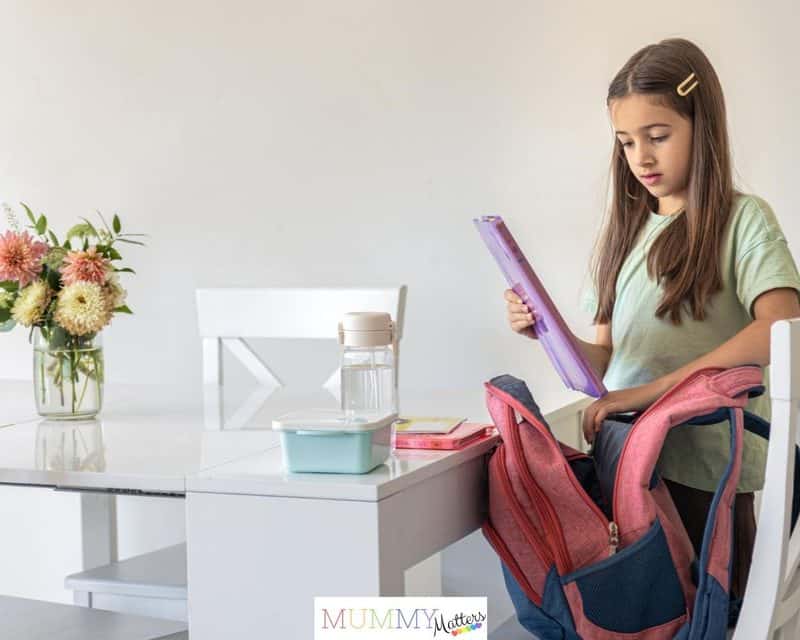
Getting everything ready before the start of term can make an uncertain event feel more manageable, but the organisation doesn’t have to stop once school begins. For children who find planning, remembering equipment or moving between tasks difficult, having simple systems at home can remove one source of stress from the school day.
Rather than organising everything for your child, involve them at a level that suits their age and abilities. You might:
- Check that their uniform and shoes feel comfortable
- Label belongings that are easily misplaced
- Pack or check the school bag together
- Keep frequently needed equipment in the same place
- Look at the timetable together so they know what they need the following day
- Talk through transport or arrival arrangements
- Decide what they will have for breakfast or lunch
- Identify anything they regularly worry about forgetting
For a child with sensory sensitivities, new uniform or shoes can introduce an additional difficulty that adults may not immediately notice. Wearing them at home first can help identify uncomfortable seams, fabrics, labels or pressure points before they have to cope with those sensations alongside all the other demands of school.
If forgetting equipment is a recurring problem, try to solve the system rather than repeatedly reminding your child to “be more organised”. A short checklist by the door, packing the bag at the same point each evening or keeping essential items in a consistent place may be more useful than relying on memory alone.
The aim is gradually to build independence while providing enough support for your child to succeed. Doing something independently doesn’t have to mean doing it without any prompts, systems or tools.
For some children, returning to friendships and the social side of school can feel more daunting than the lessons themselves. After several weeks away, they may worry about whether friendships have changed, who they will sit with, what they will talk about or where they will go during break and lunchtime.
If your child has a friendship that feels safe and comfortable, reconnecting before school starts can remove one uncertainty. They might send a message, arrange a short meet-up, play an online game together or simply agree where they will meet on the first morning.
If school has already started, you can still help make the social parts of the day feel more predictable. Rather than asking broadly, “How are your friends?”, you could ask whether they have someone to sit with at lunch, where they usually go at break or which parts of the school day feel easiest socially.
Don’t push your child to arrange meet-ups or maintain friendships that don’t feel comfortable simply because you think they should be socialising. Some children may prefer one close friend, structured activities or time alone during part of the school day.
If friendships are already causing anxiety, focus instead on helping your child identify where they can go and who they can approach if they feel lonely, excluded or unsure what to do. Sometimes having a plan for the difficult moments can feel more reassuring than being told, “You’ll make friends.”
A small piece of certainty—knowing where to go at lunchtime, who they can sit beside or which club they could attend—can make the social side of school feel considerably more manageable.
Contact school early when something isn’t working
If your child has expressed worries, you have noticed a change in their behaviour or something about the return to school isn’t working, it is worth communicating with school early rather than waiting until your child reaches crisis point.
You don’t need to have identified exactly what the problem is before getting in touch. Sometimes the first step is simply sharing what you are seeing at home and asking whether staff have noticed anything different at school. A child who appears to be coping in the classroom may be using a great deal of energy to get through the day, while a child who is struggling visibly may need adults to look beyond the behaviour and work out what is making things difficult.
Your message doesn’t need to be lengthy or confrontational. Explain what your child has told you or what you have observed, give specific examples where possible and ask what support could be put in place or reviewed.
It may be useful to confirm:
- Who your child can approach for help
- Where they can go if they need a quiet space
- Whether they can use an exit card or discreet signal
- How they can request a sensory or movement break
- Whether someone can check in with them during the first week
- How the school will communicate any concerns to you
- Whether their pupil passport or support plan is up to date
Be specific wherever possible. “Your child can speak to someone” is much less useful than “Your child can go to Mrs Brown in the pastoral office.”
When a child is already overwhelmed, they may be unable to identify an appropriate adult, explain the problem and ask for what they need. Any support plan should therefore be clear enough for them to use when their capacity is reduced.
Create or update a pupil passport
A pupil passport—sometimes called a one-page profile—can help staff understand a child without expecting the child to repeatedly explain their needs.
It might include:
- The child’s strengths and interests
- What they enjoy at school
- Situations they find difficult
- Signs that they are becoming overwhelmed
- Sensory needs
- How they communicate when distressed
- What helps them regain focus
- Helpful and unhelpful approaches
- Who they trust
- How they prefer adults to offer support
The child should contribute wherever possible. Their views may be different from the assumptions adults have made about them.
Keep the document concise and practical. A busy teacher should be able to understand the most important information quickly.
Remember that every ADHD or autistic child is different
There is no single set of strategies that will work for every child with ADHD or autism. A diagnosis may help explain some of the difficulties a child experiences, but it doesn’t tell you exactly what that individual child needs in every classroom or situation.
One child may regulate better with a movement break, while another needs somewhere quiet and still. One may find it reassuring when an adult checks in and asks questions, while another may need time and space before they can explain what has happened. Some children find fidget tools helpful for sustaining attention; others find them distracting.
Rather than beginning with a generic list of ADHD or autism strategies, I think it can be more helpful to start with three simple principles:
Notice. Ask. Personalise.
Notice what is happening. Has something changed? Are there patterns around particular lessons, teachers, environments, transitions or times of day? What happens before your child begins to struggle?
Ask rather than assume. When your child is calm and able to talk, ask what they experienced and what they think might have helped. School staff can do the same with a quiet, private check-in rather than drawing attention to the child in front of their peers.
Personalise the support. Use what your child tells you, alongside observations from home and school and any existing support plans, to find strategies that address the actual difficulty.
Depending on the child, helpful adjustments might include:
- Breaking instructions into smaller steps
- Providing written as well as verbal instructions
- Allowing additional processing time
- Checking that the child knows how to begin
- Providing a quieter workspace
- Allowing movement or sensory breaks
- Using a discreet method of requesting help
- Giving advance notice of changes where possible
- Offering access to a calm space
- Avoiding unnecessary public attention
These are examples rather than a checklist that every child should follow. Something that helps one child may make little difference to another, and support may need to change as your child grows or as the demands placed on them change.
Schools in England have a duty to make reasonable adjustments for disabled pupils so that they are not placed at a substantial disadvantage. A child also does not need to wait for a formal diagnosis before receiving support; their needs can be recognised and appropriate support put in place while they are waiting for assessment.
Quiet does not necessarily mean coping
When a child is visibly distressed or their behaviour disrupts a lesson, adults are more likely to notice that something is wrong. A child who becomes quiet, compliant or withdrawn can be much easier to overlook.
Being quiet doesn’t automatically mean that a child is struggling. However, if it represents a change from their usual behaviour—or appears repeatedly in situations they find difficult—it is worth being curious about what might be happening beneath the surface.
A child who appears to be doing very little may actually be:
- Trying to process an instruction
- Unsure how or where to begin
- Worried about getting something wrong
- Overwhelmed by noise, movement or other sensory input
- Mentally replaying an earlier interaction
- Struggling to switch attention from one task to another
- Unable to work out how to ask for help
- Using a great deal of energy to hide or manage their distress
There may be subtle signs too. A child might stare at the page without beginning, repeatedly check what other pupils are doing, become unusually fidgety, copy someone else’s actions because they are unsure what is expected, or appear to “zone out”.
Rather than calling attention to the child in front of the class, a quiet and private check-in can give them an opportunity to explain what they need. A teacher might ask, “Do you know what you need to do first?” or “Would it help if I showed you the first step?” rather than assuming they haven’t been listening or aren’t trying.
Sometimes the child won’t know what is wrong themselves, particularly when they are already overwhelmed. In those moments, reducing the immediate demand and giving them time to process may be more useful than asking repeated questions.
Behaviour can give us information, but the same behaviour won’t always mean the same thing. The aim is not to decode every action from a checklist; it is to notice patterns, remain curious and avoid making assumptions about what a child is thinking or feeling.
Identify a genuinely safe adult
Many school support plans identify an adult a child can approach if they are struggling. That’s useful, but simply naming someone on a plan doesn’t automatically make them a safe person from the child’s point of view.
A genuinely safe adult is someone your child feels able to approach when something has gone wrong, they are confused, overwhelmed or worried. That may be their form tutor, SENCO or teaching assistant, but it could equally be a teacher, pastoral member of staff or another familiar adult with whom they have developed trust.
Ask your child questions such as:
- “Who listens to you?”
- “Who would you feel comfortable asking for help?”
- “Is there an adult who helps you feel calmer?”
- “Who seems to understand you?”
- “Who could you go to if that person wasn’t available?”
Once you have identified someone, make the plan practical. Your child needs to know where that adult can usually be found, how they are allowed to contact them and what to do if they are teaching, absent or unavailable.
It is worth agreeing on a backup person too. “Go and find Mrs Smith” isn’t much of a support plan if Mrs Smith isn’t in school that day.
Remember that asking for help is itself a skill. When a child is already overwhelmed, finding an adult, approaching them and explaining what has happened may feel impossible.
If speaking becomes difficult when your child is distressed, consider agreeing another way for them to communicate. This might be an exit card, a written note, an email, a discreet signal or a simple agreed phrase that tells the adult they need help without requiring them to explain everything immediately.
Most importantly, check in with your child about whether the arrangement actually works. A support plan can look excellent on paper and still be inaccessible to the child it is supposed to support.
Plan for sensory and emotional overwhelm
A school day can involve a huge amount of sensory, social and emotional input. Busy corridors, fluorescent lighting, noise, smells, uncomfortable clothing, constant conversation and the need to move repeatedly between activities can all add to the demands a child is already managing.
For some children, these pressures build gradually throughout the day. Something that appears relatively minor to an adult may then become the final demand when the child has very little capacity left.
Where possible, support should help prevent overwhelm rather than only responding once a child has reached crisis point.
Depending on your child’s individual needs, their support plan might include:
- Entering or leaving particularly busy areas slightly earlier
- Access to a quiet or sensory space
- Ear defenders or noise-reducing headphones where appropriate
- A suitable place to sit in the classroom
- Sensory or fidget tools that genuinely help them
- Movement or regulation breaks
- Reasonable adjustments to uncomfortable uniform
- Advance notice of alarms, timetable changes or unfamiliar activities where possible
- Support or alternative arrangements during difficult break and lunch periods
- A discreet way to communicate that they are becoming overwhelmed
The National Autistic Society includes approaches such as sensory profiles, calm spaces, adjustments to uniform and appropriate sensory tools among the support schools may consider for autistic pupils.
A break is most useful when a child is able to access it before they reach the point where they can no longer cope. It shouldn’t be treated as a reward for good behaviour or something they have to earn by tolerating distress for as long as possible.
It can also help to work with your child to recognise their own early signs of overload. Over time, being able to notice “I’m finding this too much” and use an agreed strategy is an important form of self-advocacy—not a failure to cope.
Pay attention to friendships as well as lessons
Settling back into school isn’t only about managing lessons and completing work. Friendships, break times, group work and the unwritten social rules of school can take just as much energy to navigate.
Some ADHD or autistic children may find particular aspects of school friendships difficult. They might struggle to work out whether someone is joking or being unkind, feel unsure how to join a group, take comments literally, become caught up in disagreements or find themselves drawn into behaviour they hadn’t intended to be part of.
Your child may need support with things such as:
- Knowing how to join a conversation or activity
- Understanding jokes, sarcasm or “banter”
- Recognising when teasing has crossed into unkindness or bullying
- Knowing where to go if they don’t have anyone to spend break with
- Repairing a friendship after a disagreement
- Responding when another pupil pressures them to do something
- Recognising when a friendship repeatedly leaves them feeling uncomfortable or upset
- Knowing how and when to report a concern to an adult
Rather than simply telling your child to “ignore them”, “stay away from trouble” or “find someone else to play with”, help them think through what they could actually do. Who could they spend time with? Where could they go? What could they say if another pupil pressures them? Which adult could they approach?
Listen carefully to your child’s interpretation of what happened, while remembering that they may not have noticed every part of the interaction. Sometimes it can help to piece events together gradually rather than immediately deciding who was right or wrong.
Most importantly, support your child without making them responsible for another pupil’s behaviour. Social skills support can help a child navigate difficult situations, but it should never become an expectation that they must learn to tolerate bullying, discrimination or repeated unkindness.
Make home a low-demand landing place
Some children appear to cope throughout the school day only to become emotional, irritable, exhausted or overwhelmed once they get home. Parents sometimes describe this pattern as “after-school restraint collapse”—the idea that a child has used a great deal of energy managing the demands of school and releases some of that tension once they reach a familiar, safe environment.
Whatever terminology you use, it can be helpful to think about what your child needs immediately after school rather than expecting them to switch straight into homework, conversation or another activity.
That might be:
- A drink and something to eat
- Comfortable clothes
- Quiet
- Movement or time outdoors
- Screen time or another familiar activity
- Time alone
- Time close to you without having to talk
- A predictable activity that helps them unwind
Different children will regulate in different ways, so don’t assume that quiet time is always the answer. One child may want to disappear into their bedroom for half an hour, while another may need movement, music, gaming or simply to sit beside you.
Try not to launch into questions the moment they walk through the door. “How was your day?” sounds simple, but after several hours of lessons, conversations and experiences it can be surprisingly difficult to answer.
Give your child some time to decompress unless they choose to talk straight away. Later, you might ask something more specific, such as:
- “What was the easiest part of today?”
- “Did anything make you smile?”
- “Was there anything that felt confusing or difficult?”
- “Who did you spend time with?”
- “Is there anything you would like my help with?”
You may also find that your child talks more freely while you’re driving, walking, cooking or doing something else together. They don’t necessarily need a formal conversation in order to tell you something important.
If your child regularly comes home extremely distressed, exhausted or unable to manage demands that would normally be within their capabilities, don’t assume that home is the problem simply because that’s where the behaviour appears. It may be worth looking at what is happening during the school day and whether their current support is enough.
If your child finds it difficult to recognise or manage big emotions, you may also find my guide to helping children learn to regulate their emotions useful. It looks at practical ways we can support emotional regulation rather than expecting children simply to calm themselves down.
Listen before trying to fix the problem
When your child tells you that something has gone wrong at school, the instinct to fix it can be very strong. You may immediately want to suggest what they should have done, explain the other person’s point of view or contact the school.
Unless there is an immediate safeguarding or safety concern, try to listen first.
Give your child time to tell you what happened in their own way. They may remember events out of order, focus on a detail that seems unimportant to you or need to return to the conversation later once they have processed it.
When they are ready, you can gently work through:
- What happened from their point of view
- How it made them feel
- What happened immediately before and afterwards
- What they think might have helped
- What they would like to happen next
- Whether they would like—or need—you to involve school
You don’t necessarily have to agree with your child’s interpretation of everything that happened in order to take their feelings seriously. Sometimes your role is to help them understand a situation from different perspectives; at other times, they simply need to know that you have heard them.
Where appropriate, involving your child in deciding what happens next can help them develop confidence and self-advocacy. However, that doesn’t mean leaving serious situations for them to manage alone.
Contact the school when concerns involve bullying, discrimination, safety, repeated difficulties, inappropriate responses from adults or agreed support that isn’t being provided. Depending on your child’s age and the circumstances, you can explain what you intend to raise with school and involve them in the conversation where appropriate.
If a problem is ongoing, keep a written record of incidents, conversations with school and any actions that have been agreed. This can make it much easier to identify patterns and follow up if the same difficulties continue.
Prepare a plan for difficult mornings

Even with careful preparation and the right support in place, there may be a morning when your child says they can’t go to school.
Trying to work out what to do while everyone is already distressed can quickly increase the pressure, so it can help to think in advance about how you will respond.
If your child becomes overwhelmed on a school morning, try to focus first on reducing the immediate pressure and working out what is making that particular morning difficult. Is it getting dressed? The journey to school? A particular lesson? Something that happened the previous day? A friendship problem? Worry about a teacher or piece of work? Or does the whole school day simply feel too much?
Your plan might include:
- Keeping your own voice and movements calm
- Reducing the number of verbal instructions
- Focusing on one step at a time
- Trying to identify the immediate obstacle
- Offering limited, manageable choices where appropriate
- Contacting the agreed member of school staff
- Asking whether the arrival plan can be adjusted
- Recording what happened so you can look for patterns
Try to avoid turning the morning into a battle about whether your child has to go. The immediate goal is to understand what is preventing them from managing school and what support might make the situation more manageable.
If anxiety about school begins to affect attendance repeatedly, involve the school rather than trying to manage it entirely at home. Ask for a meeting with the SENCO, pastoral team or other appropriate member of staff and look together at what may be contributing to the difficulty and what adjustments could be tried.
You may also come across the term emotionally based school avoidance (EBSA), which is used to describe difficulties attending school where emotional distress plays a significant role. If this is becoming a pattern for your child, my guide to emotionally based school avoidance (EBSA) looks in more detail at possible signs, underlying reasons and ways parents and schools can respond.
Persistent school-related anxiety shouldn’t automatically be treated as defiance or a behaviour problem. A child can need additional support even when they are academically capable, and difficulties with attendance can be a sign that something about their current situation needs closer attention.
Keep a record of difficult mornings, attendance, concerns your child raises and the support being tried. Looking across several days or weeks may reveal patterns that aren’t obvious when you’re dealing with each morning individually.
A simple back-to-school plan for parents
You don’t need to do everything in this guide at once. If you want a simpler plan to come back to, these are the main things to focus on.
Before school starts
- Gradually move sleep and morning routines towards the school timetable
- Check that uniform, shoes and other clothing feel comfortable
- Prepare school equipment and create simple systems for things that are easily forgotten
- Talk about school naturally rather than repeatedly asking whether your child is worried
- Make the social side of returning more predictable where possible
- Review your child’s pupil passport or support plan
- Confirm who they can approach if they need help
- Agree how they can ask for a break or communicate that they are becoming overwhelmed
During the first few weeks
- Keep mornings as calm and predictable as you reasonably can
- Notice changes in behaviour as well as what your child tells you
- Give them time to decompress after school
- Avoid filling every afternoon and evening with additional demands
- Ask specific questions when they are ready to talk rather than questioning them as soon as they get home
- Check whether agreed support is actually accessible to your child
- Pay attention to friendships, break times and other parts of school beyond lessons
- Praise self-advocacy, problem-solving and effort rather than focusing only on academic achievement
If things don’t go to plan
- Listen before jumping immediately to solutions
- Look for patterns rather than treating every difficult day in isolation
- Ask your child what they think might help
- Record repeated concerns or incidents
- Contact school early when something isn’t working
- Review existing support rather than assuming your child has failed to use it correctly
- Ask for further help if anxiety, distress or overwhelm begins to affect your child’s wellbeing or attendance
Most importantly, keep adapting. The plan that helps your child in September may need changing later in the term as lessons, friendships and expectations change.
You do not have to get everything right
There is no perfect back-to-school plan. You can prepare carefully, put support in place and feel as though everything is going well, only for a difficulty to appear several weeks into the term. Equally, something that helped your child last year may not be what they need now.
I think one of the most useful things we can do as parents is remain curious. If something isn’t working, it doesn’t automatically mean that our child isn’t trying hard enough, that we’ve handled it badly or that the school has failed. It means there is something we need to understand better.
Keep listening to what your child tells you, but pay attention to the things they may not yet have the words to explain as well. Notice patterns, keep communication with school open and don’t be afraid to ask for agreed support to be reviewed when your child’s needs change.
The aim isn’t to remove every difficult experience from their school life. It is to help them know that when something does become difficult, they can talk about it, ask for help and be taken seriously.
Some school years will begin smoothly, and others may take considerably more adjustment. One difficult morning, lesson, friendship or week doesn’t determine how the rest of the year will unfold.
Prepare what you can, adapt what isn’t working and keep your child at the centre of the conversation. Feeling safe, understood and supported gives them a much stronger foundation from which to learn.