
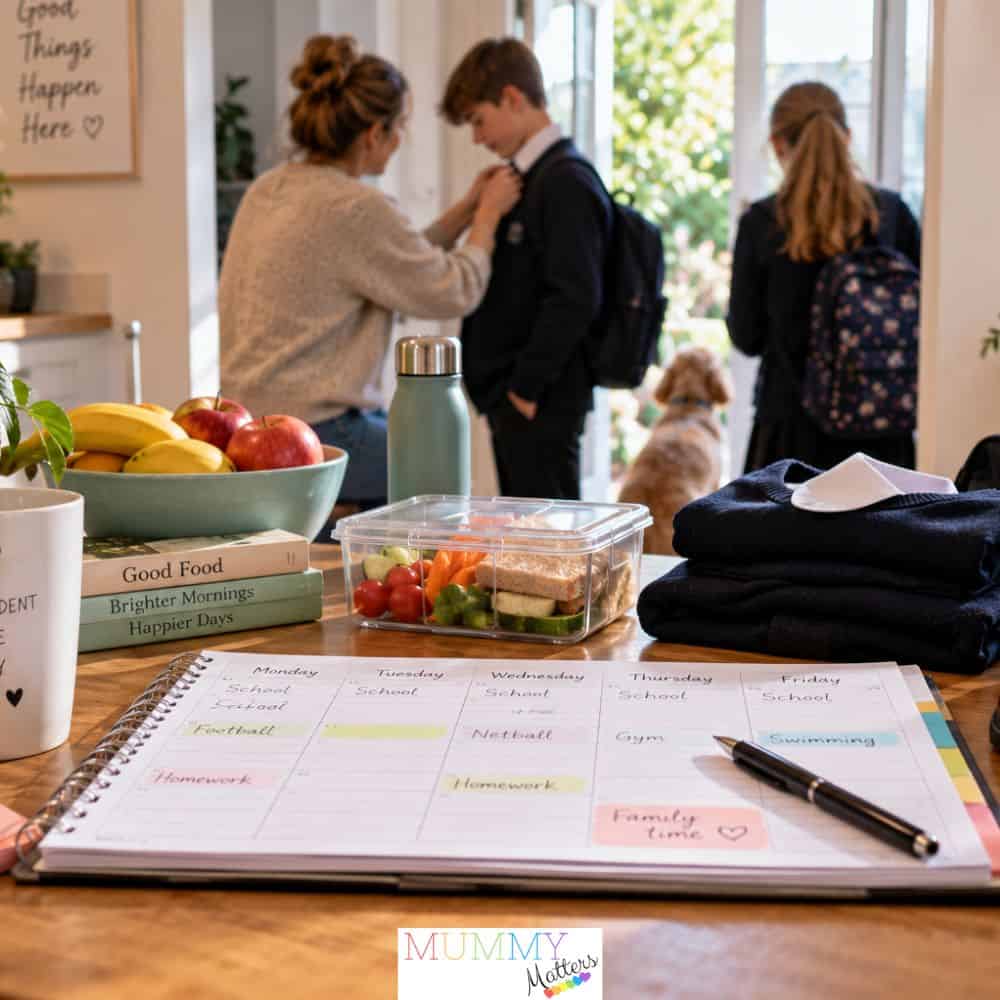
There is always a part of me that looks forward to getting back into a routine after the summer holidays. I love having the children at home, going on days out, travelling and not having to watch the clock quite so closely, but by the end of August, I am usually ready for a little more structure again.
This year, we certainly made the most of the summer right up until the very end, finishing with a brilliant (and very wet!) weekend camping at CarFest at Silverstone. Then suddenly it was September, the school uniforms were back out, the alarms were being set again and we were expected to somehow switch straight back into normal family life.
Except, of course, it doesn’t quite work like that.
After several weeks of later bedtimes, lazy mornings, irregular mealtimes and days where nobody really needed to know what day of the week it was, getting back into the school routine can be a shock to the system. And it isn’t only the children who have to adjust. I always find that I need to reset my own routine too, particularly when it comes to work, exercise, meal planning and generally being organised.
Over the years, I’ve also learnt that trying to change everything overnight usually makes that first week back harder than it needs to be. Instead, I prefer to think of September as a gradual family reset – putting some familiar rhythms back into our days while giving everyone a little time to adjust.
If your family is finding the transition from the freedom of the summer holidays to school mornings, homework and early nights a little bumpy, these are some of the things that can help make getting back into a routine feel much more manageable.
Don’t Expect Your Family Routine to Return Overnight

One thing I have learnt over the years is that you can’t expect children to switch from summer mode to school mode overnight. Even when they are happy to be going back, those first few days can be exhausting.
During the summer holidays, our routines naturally become much more relaxed. Bedtimes creep later, mornings start more slowly, meals aren’t always eaten at the usual times and there are far fewer demands on everyone’s attention. Then September arrives and suddenly children are expected to get up early, concentrate for hours, remember timetables and equipment, navigate friendships and come home ready to do it all again the next day.
It is quite a big adjustment when you think about it.
The UK Government’s back-to-school guidance acknowledges that children often need a little time to adjust after the long summer break and recommends gradually bringing familiar routines back into family life.
I’ve found it helps to treat the first week or two as a transition period rather than expecting everything to run perfectly from day one. There might be forgotten PE kits, tired children, slightly grumpy mornings and evenings when everyone has had enough. That doesn’t mean your new routine isn’t working; it might simply mean everyone is still finding their feet.
Rather than trying to fix everything at once, concentrate on getting a few important family routines back into the day – particularly waking up, eating regular meals and going to bed at a sensible time. Once those start feeling normal again, the rest of the family routine tends to become much easier.
Get Bedtimes Back on Track
Bedtimes are usually one of the first routines to disappear in our house during the summer holidays. When there is no alarm going off for school the following morning, it is very easy to let everyone stay up later – especially as the children get older.
The problem comes when those late summer nights meet a 6.30am school-day alarm.
If bedtimes have slipped considerably over the holidays, trying to suddenly send everyone to bed an hour or two earlier doesn’t necessarily mean they will fall asleep any earlier. A gradual approach can work much better. The NHS recommends bringing bedtime forward little by little until you reach the time you are aiming for, alongside creating a consistent wind-down routine.
That wind-down doesn’t need to be complicated. It could simply mean turning screens off, having a shower, getting everything ready for the following morning and spending a little time reading or relaxing before bed. Doing roughly the same things in the same order each evening can help signal that the day is coming to an end.
Screens are another thing worth thinking about. NHS sleep advice recommends switching off phones, tablets, computers and other screens before bedtime, as they can make it harder to wind down and fall asleep.
With teenagers, I think you also have to be realistic. I’m not going to pretend that I can send my teenagers upstairs at 8pm with a story and have them happily asleep by nine! Instead, the aim in our house is to help them recognise how much better they feel when they have had enough sleep and encourage them to take some responsibility for their own bedtime routine.
If the first week back at school leaves your child absolutely shattered, don’t be afraid to make evenings quieter for a while either. Sometimes an early night and a less ambitious evening are exactly what they need while their body adjusts to the school routine again.
Make School Mornings Easier the Night Before
School mornings can quickly become stressful when everyone is trying to find uniforms, pack bags, eat breakfast and get out of the door at the same time. One of the simplest ways I’ve found to make mornings easier is to do as much as possible the night before.
I encourage the children to check their timetables and pack their school bags before they go to bed, particularly if they need PE kits, homework or anything else that isn’t part of their usual everyday kit. Getting uniforms ready the night before also avoids the last-minute discovery that the trousers someone needs are still sitting at the bottom of the laundry basket!
The Department for Education recommends bringing back familiar habits such as preparing school bags and choosing clothes the night before as part of the transition back into the school routine.
As children get older, this is also a good opportunity to gradually hand some of the responsibility over to them. I don’t think my job is to remember everything for my children forever. I’d much rather help them develop their own systems for remembering what they need – although that doesn’t mean I never give a last-minute reminder when I can see something important sitting by the front door!
If mornings are particularly difficult in your house, think about what usually causes the stress and see whether you can remove that decision or task from the morning altogether. You could make packed lunches the night before, put shoes and coats where they can actually be found, decide what everyone is having for breakfast or keep a simple checklist somewhere visible.
The goal isn’t to create a military-style morning routine. It’s simply to leave enough breathing space that everybody can get out of the door without starting the day feeling frazzled.
Bring Regular Mealtimes Back
Food is another area where our routine tends to become much more relaxed during the summer holidays. Breakfast might happen at 10am, lunch becomes a picnic on a day out, dinner is later because we’re making the most of the evening, and there always seems to be somebody wandering into the kitchen looking for a snack.
There’s nothing wrong with that – it’s part of enjoying the freedom of the summer holidays – but once school starts again, I find that bringing some structure back to mealtimes helps the whole day fall into place.
Breakfast is particularly important on school mornings. It doesn’t have to be anything elaborate, especially when you’re trying to get several people out of the door on time. Cereal, toast, yoghurt and fruit, or eggs on days when we have a little more time are all easy options in our house. The NHS recommends eating breakfast as part of a balanced diet and has plenty of quick breakfast ideas specifically aimed at busy families.
After school is another time when it helps to have a plan. My children are usually hungry when they walk through the door, so having a few easy snacks available means they aren’t immediately raiding the cupboards while I’m trying to think about dinner.
Then there is the evening meal. With school, work, clubs and activities starting up again, eating together at exactly the same time every evening isn’t always realistic. I try not to get hung up on creating a perfect family dinner every night. What matters more to me is having a rough plan for what we’re eating and knowing which evenings are going to be particularly busy.
This is where getting back into meal planning really helps. Even deciding on four or five dinners for the week before doing the food shop removes one more decision from an already busy weekday evening.
Regular mealtimes don’t need to mean eating by the clock. They’re simply another familiar anchor in the day, helping everyone move from the unpredictability of summer back towards the rhythm of the school week.
Reintroduce Homework Without Making Evenings Miserable
Homework is another part of the school routine that can feel like a bit of a shock after six weeks without it. I don’t think there is one perfect time for every child to do their homework, and over the years I’ve learnt that what works for one child won’t necessarily work for another.
Some children prefer to come home, grab a snack and get their homework out of the way while they are still in school mode. Others need some proper downtime before they are ready to concentrate again.
I think that decompression time after school is particularly important for children who find the school day mentally, socially or sensory demanding. They’ve already spent hours listening, concentrating, following instructions and navigating everything that comes with being at school. Sometimes they simply need to come home, have something to eat and switch off for a while before being asked to focus again.
The important thing is finding a routine that works for your child while still making sure homework doesn’t get pushed so far into the evening that everybody is tired and it becomes another source of stress.
It can also help to break larger pieces of homework into smaller, more manageable chunks rather than expecting your child to sit for hours until everything is finished. A quiet place to work, fewer distractions and knowing exactly what needs to be completed can make getting started feel much less overwhelming.
As children get older, I think our role gradually changes too. Rather than constantly asking whether homework has been done, we can help them learn to check deadlines, prioritise tasks and manage their own time. They might not always get it right, but learning how to organise their workload is an important skill in itself.
And if homework is regularly causing tears, arguments or genuine distress, I wouldn’t simply assume that your child needs to try harder. It may be worth talking to their teacher to find out whether they are struggling with the work itself, the amount they have been given or something else that is making homework particularly difficult.
The aim is to make homework one manageable part of the evening rather than allowing it to take over family life.
Decide Where Screens Fit Into the New Routine
Screen time is another thing that tends to increase in our house during the summer holidays. There are more opportunities for gaming, watching TV, scrolling on phones and chatting to friends online when there isn’t a school day to work around.
Once school starts again, I don’t think the answer is necessarily to suddenly announce a huge screen-time crackdown. For older children and teenagers especially, screens are part of everyday life. They use them to socialise, relax, complete schoolwork and keep up with friends as well as for entertainment.
Instead, I think it is more useful to look at where screens fit into the family routine and whether they are getting in the way of anything more important.
For us, that means thinking about things such as homework, family meals, getting ready for school the following morning and, perhaps most importantly, sleep. If gaming or scrolling means homework is constantly being rushed at the last minute or somebody is still wide awake on their phone when they should be sleeping, that’s when the balance probably needs adjusting.
Rather than focusing only on how many hours children spend on screens, it can be helpful to agree on a few boundaries that make sense for your family. You might decide that phones stay away from the dinner table, gaming happens after homework is finished or devices are put down before bedtime.
It’s also worth remembering that not all screen time is the same. An hour spent FaceTiming a friend, researching something for homework or creating something isn’t necessarily equivalent to an hour of endlessly scrolling through social media.
As children become teenagers, I think conversations work better than simply imposing rules without explanation. We can help them understand why sleep, exercise, schoolwork and spending time away from screens matter while gradually giving them more responsibility for managing their own habits.
And, of course, we adults have to look at our own habits too. It’s difficult to insist that everyone else puts their phones down while we’re sitting beside them scrolling through ours!
The aim isn’t to make screens the enemy. It’s to make sure they fit around family life rather than allowing family life to fit around them.
Put Activities Back Into the Family Calendar

September always seems to go from nothing happening to absolutely everything happening at once. School starts, after-school clubs return, sports training begins again, appointments appear and suddenly the relaxed summer calendar looks very different.
This is when I find having one place where we can see what everybody is doing becomes essential.
At the beginning of the school year, I try to add all the dates we already know about to the family calendar – term dates, INSET days, school events, appointments, clubs and anything else that affects the week. Then, as new dates come through from school, I add them straight away rather than relying on myself to remember them later.
For younger children, or children who like to know exactly what is happening, a visible weekly timetable can be helpful too. The Department for Education’s back-to-school guidance suggests using a simple visual timetable to help children become familiar with things such as who will be picking them up and which after-school clubs they will be attending.
It is also worth looking at the week as a whole rather than considering every activity individually. Three clubs might sound perfectly manageable until you realise they all fall on consecutive evenings alongside homework, school commitments and everything else family life throws at you.
I’ve become much more conscious of leaving some empty space in our calendar as the children have grown older. Not every afternoon or evening needs to be filled. Having time at home to relax, catch up or simply do nothing can be just as valuable as another activity.
A family calendar isn’t about scheduling every minute of everybody’s lives. For me, it’s about being able to look ahead and spot the busy days before they arrive – rather than discovering at 4pm that somebody needs to be in two different places at once.
Remember That Children May Be Exhausted
One thing that always strikes me during the first week back at school is just how tired the children can be. Even when they have had a good night’s sleep, getting through a full school day again takes a lot of energy after the freedom of the summer holidays.
And it isn’t necessarily physical tiredness.
A school day involves concentrating, listening, remembering instructions, moving between lessons, dealing with noise and busy classrooms, navigating friendships and following rules for several hours at a time. For children who find returning to school particularly difficult, I’ve also shared some practical ways to ease back-to-school anxiety.
The Department for Education’s back-to-school guidance recommends giving children time to unwind when they come home. It points out that different children may need different things: one might need to move and burn off some energy, while another might want a quiet activity or simply a few minutes curled up on the sofa.
I’ve certainly learnt not to bombard my children with questions the moment they walk through the door. Sometimes asking, “How was school?” when they have only just escaped through the school gates is unlikely to get much more than “fine” anyway!
Giving them time to have a drink, grab a snack and decompress often means they are much more willing to talk later.
I also try to keep the first couple of weeks back relatively gentle where possible. If a child is visibly exhausted, an evening at home can be more valuable than filling every spare hour with activities. The same applies at weekends. September doesn’t have to become a race to sign up for everything immediately.
It’s worth remembering that tiredness can sometimes show itself as irritability, tears or a shorter temper too. A child who appears particularly grumpy after school may simply have used up all of their patience and energy getting through the day.
Of course, you know your child best. If their exhaustion seems excessive, doesn’t begin to improve as they settle back into school, or you are concerned about changes in their physical or emotional wellbeing, it is worth looking into it rather than automatically putting everything down to the back-to-school adjustment.
For most families, though, a little patience, some food, plenty of rest and fewer expectations can make those first couple of weeks much easier.
Reset Your Own Routine Too
When we talk about getting the family back into a routine, most of the focus naturally falls on the children. But I usually reach September needing a bit of a reset myself.
My working routine changes completely during the summer holidays. I’m trying to fit work around having the children at home, days out, holidays and everything else we want to squeeze into those six weeks. Exercise becomes less consistent, meal planning goes slightly off track and there are always jobs that I tell myself I’ll deal with “when the children go back to school”.
Then suddenly they do – and I’m faced with a rather long list!
I’ve learnt that I don’t need to fix everything during the first week of September. Just as the children need time to adjust, I find it much easier to gradually rebuild my own routines too.
For me, that means getting back into regular working hours, planning our meals again and making time for exercise. I’m also trying to get back into a better routine at the gym rather than simply squeezing it in whenever I can.
Your reset might look completely different. Perhaps you want to start taking a walk after the school run, get on top of the housework, return to a hobby, sort out your finances or simply enjoy drinking a cup of tea while it’s still hot now that the house is quiet!
Whatever it looks like, I think it’s important that the September reset includes something for us too. Looking after ourselves isn’t time taken away from our families. Having routines that help us feel organised, rested and more like ourselves can make family life feel easier as well.
The NHS recommends starting with small, achievable changes when building healthier habits rather than setting unrealistic goals that are difficult to maintain. The NHS recommends setting small, achievable goals when trying to become more active rather than giving yourself a difficult target that makes you more likely to give up. That’s an approach I think works just as well when you’re trying to reset other areas of family life too.
So, rather than creating an enormous September to-do list, I’m concentrating on putting a few useful habits back into my week and building from there. The children’s routines might change as they grow, but I’ve realised that having a few routines of my own matters too.
Have a Sunday Family Reset
One habit I find particularly useful once school starts again is having a quick family reset on a Sunday. This isn’t about spending the entire day preparing for Monday – nobody wants Sunday evening to feel like an extension of the working week – but taking a little time to look at what is coming up can make a huge difference.
I start by checking the family calendar. Who has clubs this week? Are there any appointments? Does anybody need a PE kit, ingredients for a Food lesson, money for something at school or a lift somewhere they wouldn’t normally need one?
It’s amazing how many potential Monday-morning dramas can be spotted simply by looking at the week ahead.
Sunday is also a good opportunity to check uniforms, make sure school bags haven’t developed any surprises over the weekend and think about meals for the next few days. I don’t necessarily plan every meal down to the last detail, but knowing roughly what we’re eating – particularly on our busiest evenings – saves a lot of last-minute stress.
As the children have got older, I’ve tried to make this less about me organising everybody and more about encouraging them to think about their own week too. They can check their timetables, homework deadlines, work shifts, football, clubs and anything else they have coming up.
You could even spend ten minutes together looking at the week ahead. It gives everyone an opportunity to mention something they may have forgotten to tell you and means the whole family has a better idea of which days are going to be busy.
Most importantly, keep the reset manageable. You don’t need perfectly organised cupboards, seven days of meals prepped in matching containers and every item of clothing ironed before you can consider yourself ready for Monday.
Sometimes knowing where everybody needs to be, having clean school uniforms and making sure there is food in the fridge is organised enough.
A Sunday reset isn’t about creating a perfect week. It’s simply about giving Monday morning a slightly easier starting point.
Aim for Rhythm, Not Perfection
Getting back into a family routine after the summer holidays doesn’t happen overnight. Even now, we’re still finding our feet with school mornings, work, activities, meals and everything else that suddenly fills the calendar again in September.
I’ve learnt not to judge the success of our family routine by whether every morning runs perfectly or every evening goes according to plan. With children, work and family life, something will always crop up. Somebody will forget something, dinner will occasionally be later than planned and there will inevitably be mornings when we’re searching for something five minutes before we need to leave the house.
What helps is having a few familiar rhythms to fall back on.
Regular bedtimes, preparing for school the night before, having a rough idea of what we’re eating, checking the calendar and giving everyone some downtime create enough structure to keep family life moving without making it feel rigid.
And if your first week back hasn’t gone quite as smoothly as you’d hoped, don’t write September off as a failure. Tomorrow is another opportunity to tweak what isn’t working and try again.
For us, the summer holidays ended on a high with a very wet but brilliant weekend camping at CarFest at Silverstone. I’m currently working my way through hundreds of photographs and far too many notes so that I can share our first CarFest experience properly with you very soon.
For now, though, I’m quite happy to enjoy getting back into our normal family rhythm – preferably with fewer alarms, missing PE kits and cries of “Mum, have you seen my…?” as the weeks go on!