

When a couple decides to try for a baby, much of the advice about preparing for pregnancy tends to focus on the woman. We hear about taking folic acid, eating well, reviewing medication, avoiding alcohol and generally getting our bodies ready for pregnancy. Yet conception involves two people, and the health of the prospective father matters too.
This was something that became much more apparent to me when I started looking more closely at preconception health. We planned each of our pregnancies, and while I remember thinking carefully about my own health and what I could do to prepare my body, there was far less conversation at the time about what men could do before trying for a baby. Thankfully, that conversation is beginning to change.
Sperm health can be affected by medical conditions, medication and certain lifestyle factors, and because sperm take time to develop, the months before conception provide a useful opportunity for men to think about their health too.
That doesn’t mean following a perfect diet, giving up everything you enjoy or spending a fortune on supplements promising to “boost male fertility”. Fertility is far more complicated than that, and even a healthy semen analysis cannot guarantee conception. What men can do is understand the factors that may affect sperm health, make realistic evidence-based changes where appropriate and know when it is worth asking a healthcare professional for advice.
If you are at the beginning of this journey, I recommend starting with my guide to preconception health for women and men, which looks at preparing for pregnancy as a couple. In this article, we’re going to look specifically at sperm health, what the evidence tells us can affect it and which changes may actually be worth making.
Medical note: This article provides general information and is not a substitute for individual medical advice. Do not stop prescribed medication or hormone treatment without speaking to your GP or specialist.
What does “healthy sperm” actually mean?

When people talk about sperm health, the conversation often focuses on sperm count. It is important, but it is only one part of the picture. When a semen sample is analysed in a laboratory, several different characteristics are considered, including:
- Sperm concentration or count: how many sperm are present in the sample.
- Motility: how well the sperm are able to move.
- Morphology: the size and shape of the sperm.
- Semen volume: the amount of fluid produced in the sample.
These results help healthcare professionals build a picture of sperm health, but they are not a simple pass-or-fail fertility test. Semen measurements can vary from one sample to another, and a result outside the expected range does not necessarily mean that natural conception is impossible. Equally, results within the expected ranges cannot guarantee that pregnancy will happen.
This is also why an unexpected result is not usually judged on one semen sample alone. If an initial semen analysis suggests there may be a problem, the NHS explains that another test will usually be carried out around three months later. If the second test also identifies an issue, further investigation may be recommended.
How long does it take to improve sperm health?
If you are making lifestyle changes before trying for a baby, it is useful to think in terms of months rather than days or weeks. Sperm production and maturation take roughly three months, which is why the three months before conception are often considered a useful window for looking at male preconception health.
It also means that making a change today is unlikely to transform sperm quality overnight. If factors such as smoking, excessive alcohol, diet or certain lifestyle habits are having an effect, any potential improvement will take time.
However, three months should be viewed as a useful planning window rather than a deadline or a guarantee. Some causes of reduced sperm count or quality are linked to medical, hormonal, genetic or structural factors and will not be corrected simply by changing your lifestyle.
And if you have already started trying for a baby, there is no need to stop while you spend three months attempting to create the “perfect” lifestyle. You can make sensible changes as you go. Preparing for pregnancy is about reducing avoidable risks and supporting your overall health, not achieving perfection before you are allowed to try.
Can men really improve their sperm health?
Sometimes, but it depends on what is affecting sperm health in the first place.
Certain factors are within our control. Smoking, excessive alcohol consumption, anabolic steroid use, carrying excess weight and repeated exposure to high temperatures are among the things that may affect sperm quality and can potentially be changed.
Other causes are not something you can simply fix by eating better or exercising more. Infections, hormonal problems, genetic factors, previous cancer treatment and some medical or structural conditions may require investigation and treatment from a healthcare professional.
Sometimes, there is no obvious explanation at all.
That is an important point to remember as we go through the lifestyle changes below. These are sensible ways to support your general and reproductive health, but they should never be presented as a guaranteed way to improve fertility or as evidence that someone experiencing fertility problems has done something wrong.
Stop smoking
If you smoke, stopping is one of the clearest positive changes you can make for both your general health and your reproductive health. NICE advises that smoking is associated with reduced semen quality, so giving up is worth considering when preparing to try for a baby.
Of course, knowing that you should stop and actually finding it easy to do are two very different things. If you are struggling to quit, you do not have to rely on willpower alone. NHS stop-smoking services can provide practical support and advice about treatments that may help.
Ideally, this is something to think about during the months before trying for a baby, but don’t fall into the trap of thinking you have missed your opportunity if you have already started trying. Stopping smoking at any stage is worthwhile for your wider health as well as creating a smoke-free environment for your future family.
Keep alcohol within sensible limits
Alcohol is another area where fertility advice online can quickly become quite extreme, with men sometimes being told they must give up alcohol completely for three months before trying for a baby. The current UK guidance is more measured than that.
NICE advises that excessive alcohol consumption can be detrimental to semen quality. The NHS also recommends that men with a low sperm count should avoid drinking excessive amounts of alcohol and stay within the UK guideline of no more than 14 units a week, ideally spread across three or more days.
If you regularly drink more than this, cutting back is a sensible step when preparing for pregnancy. Even if you are already within the recommended limits, you may personally decide to drink less while trying for a baby, but it is important not to present complete abstinence as something guaranteed to improve sperm quality or increase the chance of conception.
Making changes together can sometimes make this easier too. Current UK guidance recommends that women who are pregnant or planning a pregnancy should avoid alcohol, so reducing what you drink as a couple can make preparing for pregnancy feel much more like a shared responsibility.
Avoid anabolic steroids and recreational drugs
If you use anabolic steroids or testosterone for bodybuilding or performance, this is particularly important to discuss with a healthcare professional when you are planning to start a family. It might seem logical that taking testosterone would support male fertility, but the opposite can happen: anabolic steroids and non-prescribed testosterone can interfere with the hormonal signals the body needs to produce sperm.
The NHS also advises avoiding recreational drugs, including cocaine, when trying to improve a low sperm count.
This is one of those situations where being completely honest with your GP matters. If you use anabolic steroids, testosterone or recreational drugs, tell them what you are taking rather than attempting to counteract the effects with supplements or products bought online.
If your testosterone or another hormone treatment has been prescribed for a medical reason, do not stop taking it without speaking to the healthcare professional responsible for your treatment. They can discuss your fertility plans with you and advise you on the safest next steps.
Review medicines and supplements with a healthcare professional
Some medicines and other products can affect male fertility, but this doesn’t mean you should start removing medication from your routine simply because you are trying for a baby. In many cases, continuing treatment for an existing health condition will be far more important.
Instead, use the preconception period as an opportunity to review what you are taking with your GP, pharmacist or specialist. Remember to mention everything, not just prescribed medication. This could include:
- prescription medicines;
- over-the-counter medicines;
- gym or bodybuilding products;
- herbal remedies;
- vitamins and fertility supplements;
- testosterone or other hormone products.
It can be easy to forget about something you have bought yourself because it doesn’t feel like “medication”, particularly vitamins, herbal remedies and sports supplements. However, these are still worth mentioning so that your healthcare professional has the complete picture.
If something you take could potentially affect fertility, they can discuss whether it needs further investigation or whether there is a suitable alternative. Never stop prescribed medication or hormone treatment without medical advice.
Aim for a weight that supports your overall health
Weight and fertility are not straightforward, and this is another area where advice needs to be given without blame or judgement. NICE advises that men with a BMI of 30 or above are likely to have reduced fertility, but an individual man’s weight or BMI cannot tell you what his sperm count will be or whether a couple will be able to conceive.
Rather than focusing on reaching a particular number on the scales purely for fertility, think about whether there are realistic changes that would benefit your overall health. Eating a balanced diet, being regularly active, getting enough sleep and gradually working towards a healthier weight, where appropriate, can all form part of preparing your body for parenthood.
Crash diets and extreme exercise plans aren’t necessary. Sustainable changes that you can continue over the longer term are far more useful than trying to transform your body during a three-month preconception window.
If you are concerned about your weight or have a condition such as diabetes or high blood pressure, your GP or a dietitian can provide advice that takes your individual health into account.
Eat a balanced diet rather than searching for a miracle food
Search online for foods that improve sperm health and you will quickly find lists of supposed fertility superfoods, from walnuts and tomatoes to dark chocolate and oysters. It is tempting to think that adding a particular food to your diet could make a significant difference, but there is no single food proven to “boost” sperm or guarantee a pregnancy.
A much more realistic approach is to concentrate on the overall quality and variety of your diet. In practice, that means regularly eating a mixture of:
- vegetables and fruit;
- wholegrain and higher-fibre carbohydrates;
- beans, pulses, eggs, fish, lean meat or other sources of protein;
- dairy foods or suitable alternatives;
- sources of unsaturated fats, while limiting foods that are particularly high in saturated fat, salt and added sugar.
Research into diet and male fertility is continuing, and some studies have found associations between particular foods, nutrients or dietary patterns and semen quality. However, an association with a sperm measurement such as concentration or motility does not necessarily mean that eating more of that food will increase the chance of conception or result in a live birth.
So, rather than completely overhauling your diet around foods marketed for fertility, look at what you already eat. Could you add more vegetables? Swap some highly processed foods for more nutritious alternatives? Eat a wider variety of foods across the week? Small, sustainable improvements are likely to be much more realistic than following a restrictive “fertility diet”.
Ultimately, the aim is not to create a perfect diet for sperm. It is to eat in a way that supports your overall health while you prepare for pregnancy.
Stay physically active without taking it to extremes
Regular physical activity supports cardiovascular health, weight management, sleep and mental wellbeing, so staying active is a sensible part of looking after your health before trying for a baby.
There is no need to follow a specialist “fertility workout” or suddenly start exercising intensely because you are planning a pregnancy. Instead, aim to meet the standard UK physical activity recommendations in a way that suits your current health and fitness level. If you have been fairly inactive, building up gradually is much more realistic than throwing yourself into an extreme training programme.
It is also worth thinking about what might accompany your exercise routine. If your training involves anabolic steroids, non-prescribed testosterone or unregulated bodybuilding supplements, these are potentially much more relevant to fertility than finding the perfect type of exercise.
As with diet, the aim isn’t perfection. Think of regular movement as one part of looking after your overall health while preparing for parenthood.
Be sensible about heat exposure
You may have heard advice about switching to loose underwear, avoiding hot baths or keeping your laptop away from your lap when trying for a baby. There is some logic behind the concern about heat: the testicles are positioned outside the body because sperm production works best at a temperature slightly below normal core body temperature.
The NHS recommends wearing loose-fitting underwear if you have a low sperm count because tight underwear can increase the temperature around the testicles and may affect sperm quality. Reducing prolonged or repeated exposure to high temperatures may therefore be a sensible precaution, particularly if you already know that your sperm count is low.
However, there is no need to become anxious about every warm bath, bike ride or evening with a laptop. The evidence around individual everyday sources of heat isn’t strong enough to say that changing one particular habit will improve your fertility or your chances of conception.
A more realistic approach is simply to reduce frequent, avoidable heat exposure where you can, without allowing it to become another thing to worry about while trying for a baby.
Think about exposure to chemicals at work
For some men, their working environment may also be worth considering. The NHS advises men with a low sperm count to try to avoid occupational exposure to certain pesticides, solvents and heavy metals, as these may affect sperm quality.
If your job regularly involves chemicals, radiation, high temperatures or other potentially hazardous substances, this doesn’t mean you need to panic or make drastic changes to your work. Follow the safety procedures provided by your employer and use the appropriate protective equipment.
If you are concerned about a particular substance or exposure, speak to your employer’s occupational health team, your GP or a fertility specialist. They can help you understand whether your individual circumstances are relevant rather than relying on general fertility advice found online.
Prioritise sleep and manageable routines
Sleep and stress often appear on lists of things men should address when trying to improve sperm health. While both are important for general wellbeing, the evidence isn’t precise enough for me to tell you that getting a particular number of hours’ sleep or reducing your stress levels will automatically improve your fertility.
I think that distinction matters because trying for a baby can quite easily turn into another source of pressure. Once you start reading about preconception health, it can feel as though every late night, stressful day, takeaway or missed workout is somehow reducing your chances of becoming a parent.
Rather than aiming for a perfectly healthy, stress-free life (which I’m fairly certain doesn’t exist), focus on creating routines that are manageable for you. Getting enough rest, making time to switch off, being active and looking after your mental wellbeing are worthwhile regardless of their direct effect on sperm.
Preparing for pregnancy should be about supporting your health as you move into the next stage of your life, not giving yourself another long list of things to worry about.
Do male fertility supplements improve sperm quality?
This is an area where the marketing can sound much more convincing than the science.
Search for male fertility supplements and you will find products containing combinations of zinc, selenium, folic acid, coenzyme Q10, carnitine and antioxidant vitamins, often accompanied by claims about supporting sperm count, motility or overall sperm health. Understandably, when you are trying for a baby, it can be tempting to feel that taking a supplement is something proactive you can do.
Research has found that some supplements may improve individual semen measurements in some men. However, an improvement in sperm concentration, motility or morphology is not necessarily the same thing as increasing the likelihood of pregnancy or bringing home a baby.
A 2025 systematic review and meta-analysis of randomised controlled trials found no convincing evidence that dietary supplements improved pregnancy or live-birth outcomes in male infertility. Although some supplements were associated with improvements in individual sperm measurements, the researchers found that the certainty of much of the evidence was low or very low.
A Cochrane review of antioxidants for male subfertility reached a similarly cautious conclusion. It found that antioxidants may improve pregnancy and live-birth rates, but the quality of the evidence was low or very low and the researchers concluded that the overall evidence remains inconclusive.
This doesn’t mean that every male fertility supplement is useless. It does mean we should be wary of products promising to “optimise” sperm, repair sperm DNA or dramatically improve fertility within a few weeks when the evidence doesn’t support such certainty.
Supplements aren’t automatically harmless simply because you can buy them without a prescription either. They can interact with medicines, duplicate nutrients you are already taking or provide unnecessarily high doses of particular vitamins and minerals.
Before spending a significant amount of money on a male fertility formula, particularly if you have an existing health condition or take medication, speak to your GP, pharmacist or fertility specialist about whether there is actually a reason for you to take one.
Should you use a home sperm test?
Home sperm tests are widely available and, understandably, they can seem like an appealing first step. You can take the test privately at home without having to speak to your GP or attend a fertility clinic, which may feel less daunting if you are simply curious about your sperm health.
The important thing to understand is that home tests don’t all measure the same things and they aren’t a replacement for a full laboratory semen analysis. Some primarily assess sperm concentration, for example, while a clinical semen analysis can look at several characteristics, including sperm concentration, movement and shape.
That means a reassuring result from a home test cannot confirm that you are fertile. Equally, an unexpected or worrying result doesn’t mean you are infertile and shouldn’t be a reason to panic.
If you do choose to use a home sperm test, think of it as a screening tool rather than a diagnosis. If you have a particular reason to be concerned about your fertility, or you and your partner have been trying to conceive without success for the recommended length of time, speak to your GP about appropriate fertility investigations instead.
When should a man speak to his GP?
If you and your partner have been trying for a baby without success, you don’t have to work everything out by yourselves. The NHS recommends speaking to your GP if you have been having regular sex without contraception for more than one year without conceiving. If your female partner is aged 36 or over, the NHS advice for low sperm count is to seek help after six months.
It’s also important to remember that fertility is a couple’s issue rather than assuming that one person is responsible. Ideally, both partners should be assessed because fertility difficulties can affect either or both of you.
There are also situations where it makes sense to ask for medical advice sooner rather than waiting for six or twelve months. For a man, these could include if you have:
- had cancer treatment, chemotherapy or radiotherapy;
- used anabolic steroids or testosterone;
- had surgery or an injury involving your testicles or groin;
- had undescended testicles or have a known genital condition;
- difficulty with erections or ejaculation;
- pain, swelling or a lump in a testicle;
- had a previous genital infection or think you may have had an STI;
- a long-term health condition or take medication that may affect fertility;
- another specific reason to be concerned about your fertility.
And importantly, don’t wait until you have been trying for a certain length of time before seeking medical advice about symptoms such as a new testicular lump, persistent pain or swelling. Those symptoms deserve assessment in their own right.
What happens during a semen analysis?
If your GP thinks further investigation is appropriate, one of the main tests for male fertility is a semen analysis. This involves providing a semen sample which is then examined in a laboratory. Among other measurements, the laboratory will look at the number of sperm present, how well they move and their shape.
You will be given instructions explaining how to prepare for and collect your sample. It is important to follow the instructions from your particular clinic carefully, as factors such as the length of time since you last ejaculated, how the sample is collected and how quickly it reaches the laboratory can affect the result.
If your first semen analysis shows a possible problem, you will usually be offered another test. NICE recommends that a repeat confirmatory test should ideally take place around three months after the first, allowing time for another cycle of sperm production. In some circumstances, such as when a very severe sperm deficiency is identified, the repeat test may be carried out sooner.
If further tests continue to show a problem, you may be referred to a specialist. Depending on your individual circumstances, further investigation could include blood tests, examination of the testicles, an ultrasound scan or other tests.
For many men, the idea of providing a semen sample can understandably feel awkward or embarrassing. Try to remember that this is a routine clinical test. The result isn’t a judgement on your masculinity or your ability to become a father;
A realistic three-month sperm-health checklist
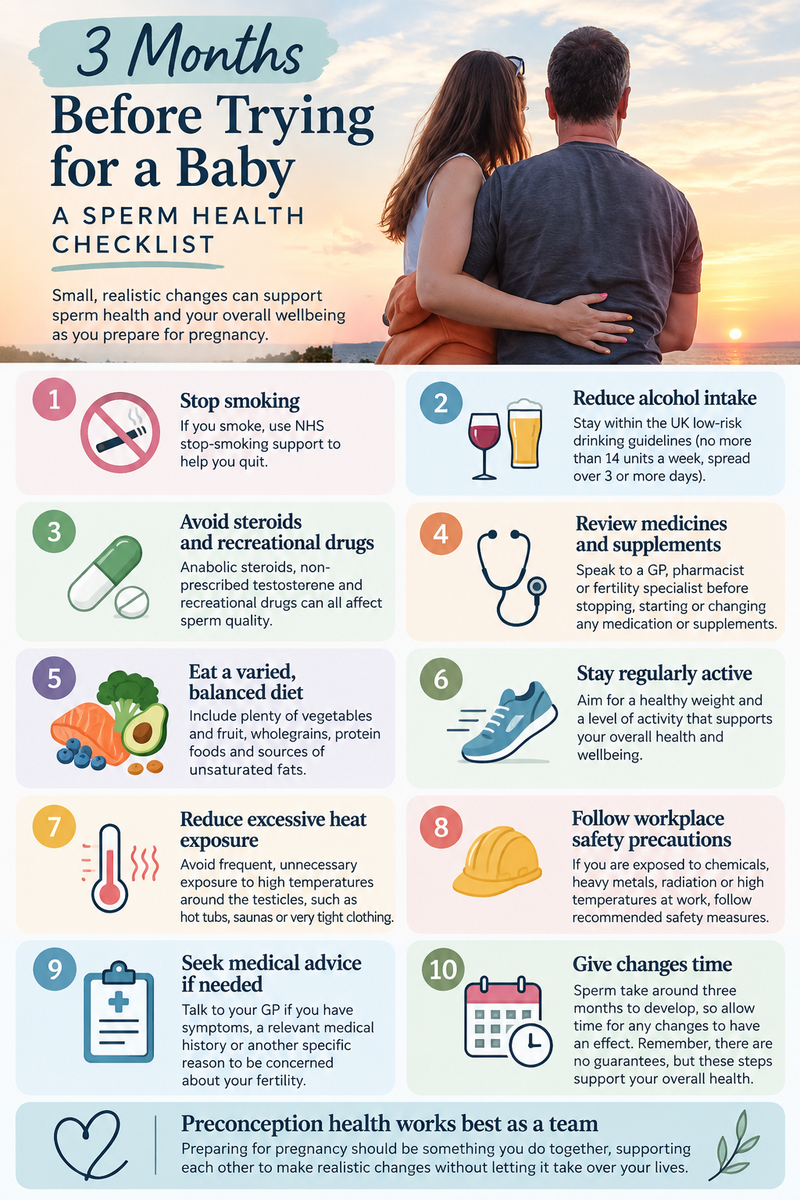
If you know that you would like to start trying for a baby in the next few months, you can use the roughly three-month sperm-development window as a prompt to look at your health and habits. You don’t need to completely overhaul your life or tick every box perfectly. Think of this as a practical starting point rather than a fertility programme.
Over the next three months, consider whether you could:
- stop smoking, using NHS stop-smoking support if you need help;
- reduce excessive alcohol consumption and stay within UK low-risk drinking guidelines;
- avoid anabolic steroids, non-prescribed testosterone and recreational drugs;
- review medicines and supplements with a healthcare professional rather than stopping prescribed treatment yourself;
- eat a varied, balanced diet without relying on supposed fertility superfoods;
- stay regularly active and work towards a weight that supports your overall health where appropriate;
- reduce frequent, avoidable exposure to excessive heat around the testicles;
- follow workplace safety precautions if you are exposed to chemicals, heavy metals, radiation or high temperatures;
- seek medical advice if you have symptoms, a relevant medical history or another specific reason to be concerned about your fertility;
- give any changes time, without expecting them to guarantee an improvement in sperm quality or pregnancy.
Most importantly, remember that this isn’t all on the man any more than preparing for pregnancy should be all on the woman. Preconception health works best when you approach it as a couple, supporting each other to make realistic changes without allowing trying for a baby to take over your lives.
Sperm health is only one part of conception
It is positive that male preconception health is finally receiving more attention. Preparing for pregnancy should not place every responsibility on the woman, and men deserve clear information about their own health before conception.
At the same time, sperm health should not become another wellness project in which couples feel pressured to buy products, follow rigid rules or blame themselves when conception takes longer than hoped. The most useful approach is usually the least dramatic: look after your general health, remove avoidable risks, ask for help when something concerns you and remember that fertility is something a couple navigates together.
Frequently asked questions
How quickly can sperm quality improve?
Sperm production and maturation take roughly three months, so changes intended to support sperm health are generally considered over months rather than days or weeks. However, improvement isn’t guaranteed and will depend on what, if anything, is affecting sperm quality in the first place.
What is the best food for healthy sperm?
There isn’t one particular food proven to improve sperm health or male fertility. Rather than concentrating on fertility “superfoods”, aim for a varied, balanced diet containing plenty of vegetables and fruit, wholegrains, protein foods and sources of unsaturated fats.
Should men stop drinking alcohol when trying for a baby?
Excessive alcohol consumption can negatively affect semen quality, so cutting down is sensible if you regularly drink above recommended levels. UK guidance recommends drinking no more than 14 units a week, spread across three or more days. Some men may choose to avoid alcohol altogether while trying for a baby, but complete abstinence shouldn’t be presented as a guarantee of improved fertility.
Can tight underwear cause infertility?
Tight underwear may increase the temperature around the testicles, and the NHS recommends loose-fitting underwear for men who have a low sperm count. However, there isn’t evidence to suggest that simply changing your underwear will prevent or correct male infertility. Think of reducing excessive heat exposure as one small part of the wider picture.
Do male fertility supplements work?
Some studies have found improvements in individual sperm measurements after taking certain supplements, but current research hasn’t provided convincing evidence that dietary supplements improve pregnancy or live-birth outcomes. If you are considering a male fertility supplement, particularly alongside medication or other supplements, speak to a GP, pharmacist or fertility specialist first.
When should we ask for fertility tests?
The NHS recommends speaking to your GP if you have been having regular sex without contraception for more than one year without conceiving. If the female partner is aged 36 or over, NHS advice relating to low sperm count recommends seeking help after six months. You should seek advice sooner if either partner has a known medical condition, relevant history, symptoms or another specific reason to be concerned about fertility.