
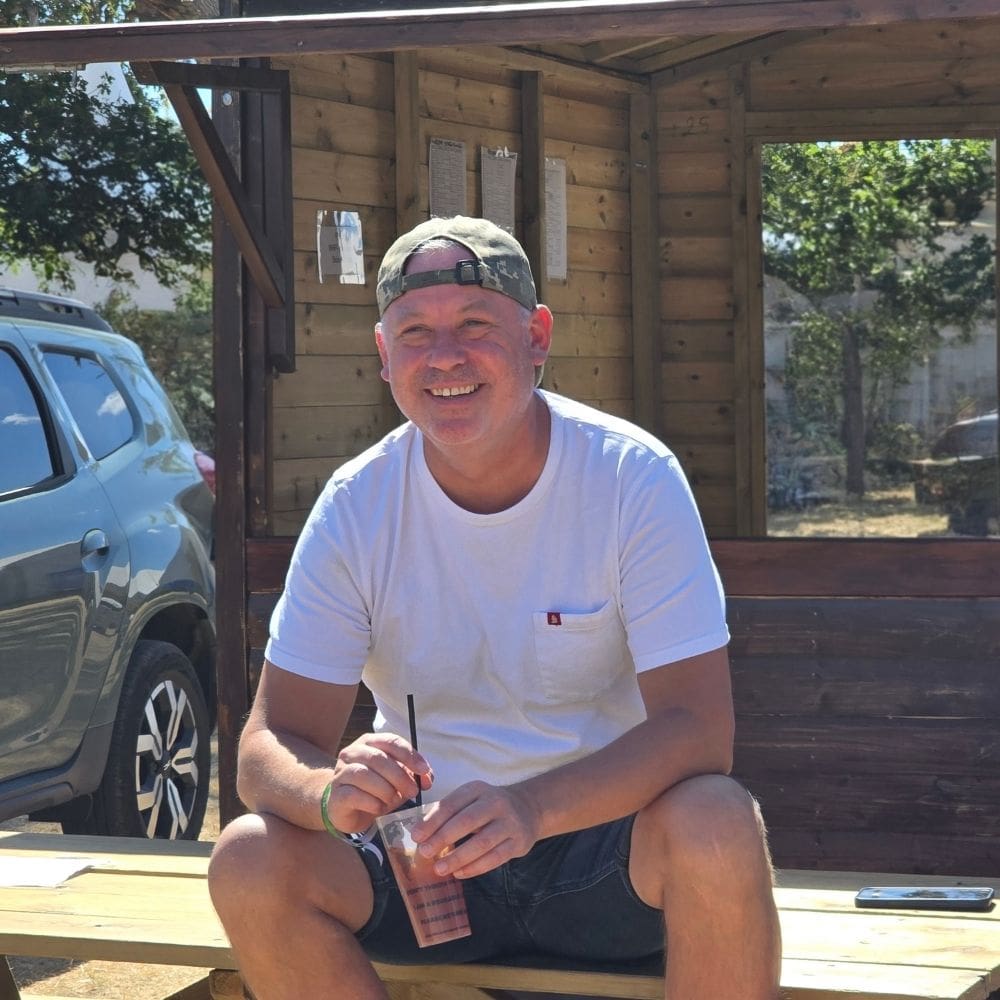
One of the people I really wanted to speak to while we were at Lakefest was its founder, Lee Martin. I didn’t have a formal interview planned or a carefully prepared list of questions, I actually just prefer to chat and see where the conversation goes. I was genuinely interested to know more about the person behind a festival of this size.
I’d actually watched Lee talking to the group of media at the press launch and something struck me about him. For somebody who runs a festival and spends his life surrounded by performers, he didn’t seem particularly comfortable being the centre of attention himself.
So, naturally, I told him that’s what I’d noticed.
He laughed and said that I was right. He isn’t really interested in being in the spotlight, and I think that was probably one of the reasons I found him so easy to talk to. Once we got chatting, the conversation just seemed to wander from one subject to another.

I asked whether he’d always worked in music and entertainment and was surprised when he said no. He’d actually been a computer salesman.
Over the years, the margins in computer sales had become smaller and smaller and it was getting increasingly difficult to make money from it. The beginnings of Lakefest came about almost accidentally when Lee decided to organise a cider festival with The Wurzels to help promote the cider.
He told me they’d originally expected to sell around 200 tickets. They ended up with closer to 500 people, did it again the following year and it just continued to grow from there.
Considering the size of Lakefest today, I love that it essentially started as a promotional idea for cider!
When things went very wrong
Our conversation took a much more serious turn when Lee told me about the theft of around £73,000 in cash from Lakefest.
I’d heard snippets about things going wrong behind the scenes at festivals before, but I wasn’t expecting him to be quite so open about the effect this had on him personally.
Lee said it really messed him up and messed with his head. He went into a very dark place afterwards and eventually left his family.
He also told me that although it was incredibly difficult at the time, life has moved on. He is now friends with his ex-wife and has a good relationship with his children.
It was probably this part of our conversation that made the biggest impression on me. When you’re standing at Lakefest watching thousands of people having a brilliant weekend, you don’t really think about what might have happened behind the scenes over the years to get the festival to where it is today.
There’s also a very practical legacy from what happened: Lakefest is now a cashless festival.
Lee writes about the theft and many of the other ups and downs of running Lakefest in his book, Festival of Love and Pain. After we’d been chatting for a while, he gave me a copy.
I haven’t read it yet – I’ve barely stopped since getting home from Lakefest – but after hearing some of the stories directly from Lee, I’m really looking forward to sitting down with it once the children return to school.
Does he still love Lakefest?
After hearing everything that had happened, I wanted to know whether Lee actually still enjoyed running the festival.
Thankfully, he said yes.
He clearly loves festivals and told me he thinks they can be brilliant for families when you get them right.
Having just spent several days at Lakefest with my own family, I could understand exactly what he meant.
For us, Lakefest was the perfect mix of live music, family fun and entertainment, but one of the things we loved most was how many new people we met along the way.
He was also very open about the fact that there had been quite a bit of trouble at Lakefest last year. This year they’d brought in better security, and he felt they were doing a much better job.
From my perspective, the atmosphere at Lakefest this year felt really friendly and relaxed. Security were visible around the site without feeling overbearing, and at no point during the weekend did I feel uncomfortable or unsafe. We saw families, groups of friends and people of all ages simply enjoying the festival together, and that friendly atmosphere was one of the things I loved most about the weekend. Knowing what Lee had told me about the problems they experienced last year, it was reassuring to hear that they’d taken those issues seriously and made changes rather than simply hoping things would be different this time.
If you’re thinking about trying a festival as a family for the first time, I’ve also put together my tips for camping at festivals with children, including the things we’ve learnt from our own festival trips over the years.
Keeping an independent festival going
Something else Lee said has stuck with me since we spoke.
Even though he still loves what he does, selling festival tickets is getting harder. There are so many festivals now that the market has become saturated, and people have a huge amount of choice about where to spend their money. As Lee put it, you have to get it right.
I think that’s easy to forget when you’re on the other side of the fence as a festival-goer. We look at a line-up and decide whether we fancy going. For the people organising it, there are months of decisions, costs and risks before anyone walks through the gates.
And in Lee’s case, he’s been doing that year after year while Lakefest has grown from a few hundred people turning up to see The Wurzels into the festival we know today.
It seems Lee certainly isn’t alone in feeling the pressure. The Association of Independent Festivals has reported just how difficult the last few years have been for independent UK festivals, with rising costs and changing audience habits making an already risky business even harder. In 2024 alone, 78 UK festivals were cancelled, postponed or closed completely, which really puts into perspective just how challenging it is to keep an independent festival like Lakefest going.
I mentioned one of the acts we’d seen the previous day. I won’t name names, but things hadn’t quite gone to plan when they first arrived at the festival, and they’d told Lee they couldn’t do it. Instead of asking someone else to deal with the situation, Lee jumped in his car and went to see them himself. He gave them a hug, reassured them, and personally escorted them into the arena to make sure they felt comfortable. That’s good-guy behaviour right there.
Why I’m glad I spoke to Lee

I came away from our chat really liking Lee.
I hope he won’t mind me saying that because I’m not trying to turn this into some kind of glowing tribute to the founder of Lakefest. I just found him very easy to talk to and refreshingly open about the fact that running a festival hasn’t always been plain sailing.
I think what surprised me most was how much I found myself wanting Lakefest to do well. We’d already had a brilliant time there, but speaking to Lee gave me a much better understanding of the person behind it and some of what has happened along the way.
I went over to ask him a few questions and came away with a book and about ten more things I wanted to ask him.
So perhaps once I’ve finished Festival of Love and Pain, I’ll have to find him again next year.