

The most significant structural error in alternative education is to base a start on the student’s age. It shouldn’t be like that. A ten-year-old student in a school district with difficulties could be reading at a seventh grade level and doing third grade arithmetic. The classified grade level doesn’t correspond to either situation. Before anything else, it is necessary to conduct a diagnostic benchmark.
This involves the use of objective standard evaluation instruments, neither the curriculum supplier’s placement questionnaires nor your simple observation; you have to determine exactly your student’s position regarding basic skills. Reading comprehension and math are the two issues that must be considered. With the help of these diagnostics, you can determine the gaps in specific abilities not the general situation. The result should not be “she is falling behind in math”, instead, it should be “she hasn’t unified the multiplication of fractions and other operations”, that’s why she can’t master everything ahead of that point. The precision will help prepare a more suitable curriculum rather than a mass school class.
Define What “Done” Looks Like Before You Start
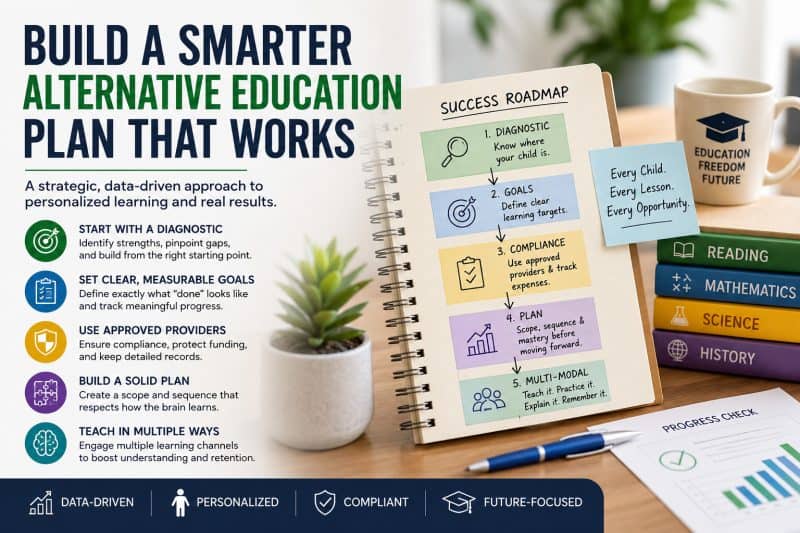
After establishing the baseline, the subsequent forethought involves formulating terminal learning objectives for each subject. These are the targets you aim to hit by the end of the school year, explicit, achievable, and tied to real standards for real learning.
Don’t describe objectives in broad terms such as “student will enhance math comprehension.” Instead, be precise: “Student will solve long division problems with a remainder of three or less.” That’s measurable, that’s attainable. And when it’s time to hand out report cards, nobody’s going to look at that and say “Well, I think my kid met that!”.
One objective per subject per quarter is a reasonable model for most students. Multiply by the number of subjects you are teaching, and you have the number of critical checks you’ll have over the year. If it’s ten objectives, you still have ten more equally spaced progress checks before the next report card comes out, and you know where you have to focus.
Funding Compliance and Selecting Approved Providers
For families using state-level ESA school funding, curriculum selection isn’t just a pedagogical decision, it’s a compliance decision. Every material, resource, and provider the funding covers must be documented and classified as an approved educational expense under program guidelines. Families who don’t track this carefully can find themselves with reimbursement denials or funding clawbacks, which disrupts the entire academic year.
The practical answer is to build your curriculum around approved providers from the start, rather than building it first and then trying to make the funding fit. Families in Arizona, for example, should partner with an Arizona ESA approved school to ensure that their coursework meets state standards and that their materials fall within the allowable expense categories. The Arizona ESA program now serves over 70,000 students (Arizona Department of Education, 2023), which means the infrastructure of approved providers has matured significantly, there are more quality options available now than there were even three years ago.
Keeping clean records is not negotiable. Every invoice, receipt, and provider agreement needs to be organized and retrievable. Many families use a simple shared folder structure by academic year and subject area. The administrative overhead is real, but it protects the funding you’ve already earned access to.
Scope and Sequence: The Architectural Backbone
A scope and sequence is the big picture architectural plan of your entire curriculum. It tells you two things: what’s being taught, and the order in which it’s being taught. Most parents who cobble together a non-traditional curriculum don’t do this part. They buy resources, set a schedule, and jump in. About six months later, they realize that their child is being exposed to things they’re just not ready to understand, and nobody can quite put their finger on why learning has plateaued.
Cognitive Load is the culprit. When you introduce a completely new, fairly complex concept, before the necessary building blocks are solidly constructed in long-term memory, they overload working memory. When that happens, retention plummets. This is not about intelligence; it’s a simple given of the neurology of how humans learn. Cognitive Load Theory is a well-established principle of educational psychology. It has the most obvious, direct application when it comes to curriculum design and sequencing: you must make absolutely sure that all building block skills are mastered before you touch on an advanced topic.
In practical terms, this means breaking your curriculum down into weekly modules. To move from Module N (where the new material is introduced) to Module N + 1 (where the new material is consolidated before moving on to the next new thing), the entry requirement is: they must have already mastered everything in Module N. The exit criterion is: they must be able to perform all the work in Module N without intervention from you. Then you must implement the single most underrated, underused, and yet most important part of learning science in teaching: the opening ten minutes of each and every lesson should be a carefully designed facilitated recall and review of the prior material.
Multi-Modal Instruction and Why Variety Isn’t Optional
Preferring a single way to teach or learn something is not the same as designing a curriculum. The latter requires that students actually retain the material, and learning science tells us people retain information better if they receive it through different “channels.” Reading about something in a book, seeing a demonstration, trying it yourself, and then explaining it to someone else do result in different parts of your brain lighting up and forming memories.
Also, some learning is more effective when done non-digitally. You have probably experienced this yourself, when your mental calculator seems to be down and you can’t remember a phone number you just found online. Shaking that hand in the first chemistry class feels more real than seeing it on the screen, that sort of thing. A completely digital courseware-driven curriculum is good for about half a semester of mathematics for most students, then the retention and understanding gains from seeing, hearing, and doing live action start to become important.
The more solidly built non-traditional curriculum should balance the written word with audio-visual resources, hands-on components, and live discussion. Not every lesson or unit needs all four forms of encounter, but some interaction with more than one format of the material must be present across each subject unit for the design to actually work.
Building a Daily Structure That Actually Holds

One of the greatest benefits of non-traditional schooling is the flexibility that it offers. However, at the same time, this flexibility could pose a risk for the system. If there is no consistent daily schedule, flexibility can soon turn into an inconsistent routine. Studies have shown that inconsistent schedules can lead to slow learning progress and a higher level of frustration for families.
A good daily schedule for non-traditional students should break the school day into blocks. One block can be dedicated to live instruction or practice with a teacher, another could be for independent asynchronous work, and the third block could be for project-based or applied learning. The lengths of these blocks may vary depending on the age of the students, but the concept of three blocks can be applied to most grades. For example, elementary students can have 45-minute blocks, while high school students can have 90-minute blocks with a 15-minute break in between.
Here, we want to emphasize the importance of asynchronous learning. This type of learning is often given to students and they are expected to get on with it. But in order for asynchronous learning to be effective, the tasks in the independent blocks should be structured. Students need to have specific tasks with clear criteria for completion. This will help them develop self-regulation skills and skills in understanding their learning process (metacognitive skills).
Formative Assessment Over End-of-Year Testing
Traditional schools often assess what students retain through summative assessments, such as final exams, and they typically take place at the end of a unit or a semester. Non-traditional curricula do not have to rely on this kind of assessment and in many cases they shouldn’t. Summative assessment only measures what a student knew on one particular day under one particular set of circumstances because of a particular level of stress.
Also, summative assessment doesn’t pinpoint where a gap in knowledge formed. Did the student fail the end-of-year unit because they missed a month of school for unforeseen circumstances in September and never recovered, or because they didn’t pay attention to the teacher in December? If you catch a gap three weeks into your curriculum, it costs you a week to close it. If you catch it on finals day, it costs you an entire year (remediation in the summer) and the beginning of next year too (repeating material the student has already learned). The more often you assess your students, the more often you get these chances to course-correct.
Preparing For What Comes After
Alternative education should still be part of a larger preparation toward life. For high school students, that means you need to design your curriculum structure with an eye toward college admissions.
Transcript preparation is a real skill. A non-traditional educator needs to document course titles, credit hours, and grading criteria in a way that a college admissions office will read without confusion. The more external documentation you have, the less likely it is that you’ll have to prove course content was taught after the fact.
Third-party validation can come from advanced placement (AP) exams, or by having students participate in a dual enrollment program at a college or university whose coursework has been endorsed by an approved national accrediting agency or state approval agency. SAT and ACT preparation should be built into the junior year schedule as a distinct curriculum unit, not tacked on as an afterthought. Blended learning arrangements, where a student takes some coursework through an accredited online provider and some through a parent-directed curriculum, often produce the strongest transcripts, because they combine the personalization of home-based instruction with the external credibility of a recognized institution. The fear that non-traditional students will have gaps that put them at a disadvantage in college applications is real but manageable. A curriculum built on the principles described here, diagnostic baseline, clear objectives, coherent scope and sequence, continuous assessment, and documentation, produces an academic record that holds up under scrutiny. The structure is what makes that possible