

Uno has been one of our family’s favourite card games for years, and it’s one of those games we always seem to come back to. Whether we’re camping, staying in a holiday cottage or simply looking for something screen-free on a rainy afternoon, a pack of Uno cards never stays in the cupboard for long.
The problem is that after a while, everyone knows the rules so well that every game starts to feel exactly the same.
The good news is that a single Uno deck can be used to play lots of different games. Whether you’re looking for a quick five-minute challenge, a game that helps younger children practise their memory or maths skills, or something completely different for family games night, there are plenty of fun alternatives to classic Uno.
Looking for a specific game? Use the table of contents below to jump straight to your favourite.
Here are some of our favourite games to play with Uno cards.
Contents showQuick Answer: What games can you play with Uno cards?
If you’re wondering what else you can do with an Uno deck, there are lots of fun alternatives to the classic game. Popular options include Uno Slap, Uno War, Uno Go Fish, Uno Memory, Uno Tower and maths games like Sum It Up. Most use the same deck of cards with just a few small rule changes, making them perfect for family game nights, rainy afternoons or holidays.
Before you start
Most of these games only use the numbered Uno cards, so you’ll need to remove any Wild, Skip, Reverse and Draw cards where instructed. If you’re playing with younger children, don’t be afraid to adapt the rules to suit their age—the aim is simply to have fun together.
| Game | Best For | Players | Ages | Time |
|---|---|---|---|---|
| Uno Slap | Fast reactions and lots of laughs | 2–6 | 6+ | 10 mins |
| Uno Go Fish | Younger children | 2–6 | 4+ | 15 mins |
| Uno War | Quick two-player games | 2 | 5+ | 10 mins |
| Uno Crazy Eights | Fans of classic card games | 2–5 | 7+ | 15–20 mins |
| Uno Tower | Parties and family gatherings | 2–8 | 6+ | 15 mins |
| Sum It Up | Practising maths skills | 2–6 | 6+ | 15 mins |
| Uno Reverse Challenge | Competitive players | 2–6 | 7+ | 15 mins |
| Uno Memory | Quiet family games | 2–4 | 4+ | 10 mins |
| Uno Colour Challenge | Younger children | 2–6 | 4+ | 10 mins |
| Create Your Own House Rules | Creative families | 2–10 | 6+ | Flexible |
1. Uno Slap
Best for: Fast-paced family fun
Players: 2–6
Recommended age: 6+
Playing time: Around 10 minutes
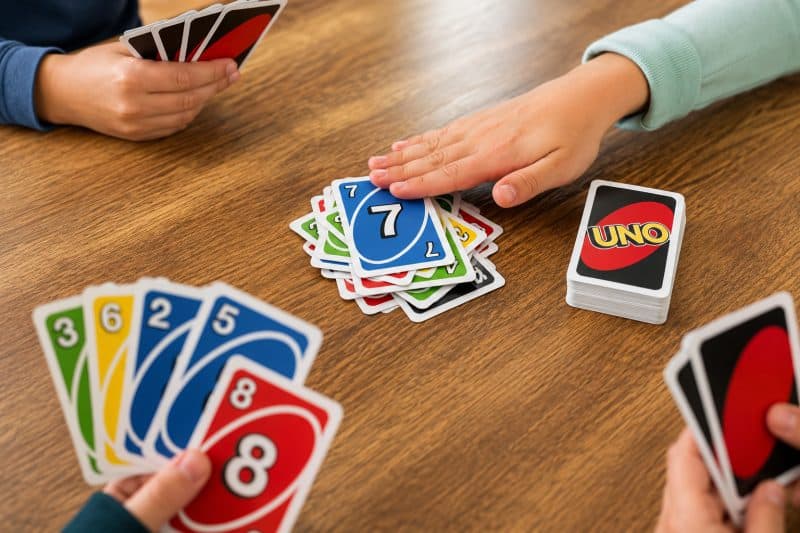
If your family loves games that involve quick reactions, Uno Slap is guaranteed to get everyone laughing. It’s chaotic, competitive and usually ends with somebody dramatically diving across the table to grab the pile before anyone else.
Unlike traditional Uno, speed matters just as much as paying attention.
What you’ll need
- One standard Uno deck
- Number cards only (remove all Wild, Reverse, Skip and Draw cards)
How to play
- Shuffle the numbered cards and deal them evenly between all players.
- Players keep their cards face down in a pile.
- Everyone turns over their top card at the same time into the middle.
- Whenever two consecutive cards match in either number or colour, everyone races to slap the pile.
- The first player to slap the pile wins all of the cards.
- Continue until one player has collected every card.
Mummy Matters Tip
This is one of those games that’s guaranteed to get noisy! We always make sure there’s plenty of room around the table because enthusiastic slapping usually sends cards flying everywhere. If you’re playing with younger children, you could make the rules a little easier by only slapping when the colours match.
2. Uno Go Fish
Best for: Younger children and mixed-age families
Players: 2–6
Recommended age: 4+
Playing time: Around 15 minutes
If your children already know how to play Go Fish, this Uno version is incredibly easy to learn. Instead of using a traditional pack of playing cards, you simply use the numbered Uno cards. It’s a brilliant way to introduce younger children to taking turns, matching numbers and remembering what other players have asked for.
What you’ll need
- One Uno deck
- Number cards only (remove Wild, Skip, Reverse and Draw cards)
How to play
- Shuffle the numbered cards.
- Deal five cards to each player (or seven if there are only two players).
- Place the remaining cards face down to create the draw pile.
- Players take turns asking another player for a specific number, for example, “Do you have any 7s?”
- If they have one or more matching cards, they must hand them over.
- If they don’t, they say “Go Fish” and the player draws one card from the pile.
- Continue until all possible pairs have been collected.
- The player with the most pairs wins.
Mummy Matters Tip
This is one of my favourite versions to play with younger children because the rules are already familiar. If little ones struggle to remember numbers, let them keep their cards spread out in order from 0 to 9—it makes the game less frustrating and helps build confidence.
3. Uno War
Best for: Quick games with younger children
Players: 2
Recommended age: 5+
Playing time: Around 10 minutes
If you’ve ever played the classic card game War, this Uno version will feel instantly familiar. It’s incredibly easy to set up, making it a great choice when you only have two players or want a quick game before bedtime or dinner.
Because there are very few rules to remember, it’s also ideal for younger children who are still building confidence with card games.
What you’ll need
- One Uno deck
- Number cards only (remove all Wild, Reverse, Skip and Draw cards)
How to play
- Shuffle the numbered cards.
- Divide the deck equally between the two players.
- Without looking, each player turns over their top card at the same time.
- The player with the highest number wins both cards and places them at the bottom of their pile.
- If both players reveal the same number, declare “Uno War!” Each player places two cards face down followed by one card face up. The highest face-up card wins all of the cards in the middle.
- Continue until one player has collected every card.
Mummy Matters Tip
You can make this game more exciting by keeping a running score over several rounds instead of playing until one player wins every card. We’ve found this works much better if younger children start to lose interest during longer games.
4. Uno Crazy Eights
Best for: Families who enjoy traditional card games
Players: 2–5
Recommended age: 7+
Playing time: Around 15–20 minutes
Crazy Eights has been around for generations, and it’s surprisingly easy to recreate using an Uno deck. If your family already enjoys classic card games, this version feels familiar while still making the most of Uno’s colourful cards.
The aim is the same as traditional Crazy Eights – be the first player to get rid of all your cards by matching either the colour or the number of the card on the discard pile.
What you’ll need
- One standard Uno deck
- You can play with the full deck or remove the Wild Draw cards if you want a simpler game.
How to play
- Shuffle the cards and deal seven cards to each player.
- Place the remaining cards face down to form the draw pile.
- Turn over the top card to start the discard pile.
- Players take turns matching either the colour or the number of the top card.
- If a player can’t make a move, they draw one card from the draw pile.
- Continue until one player has played all of their cards.
Mummy Matters Tip
If you’re introducing younger children to card games, this is a lovely stepping stone before moving on to full Uno. The rules are slightly simpler, so children can focus on recognising colours and numbers without remembering lots of action cards.
5. Uno Tower
Best for: Parties, sleepovers and family games night
Players: 2–8
Recommended age: 6+
Playing time: Around 15 minutes
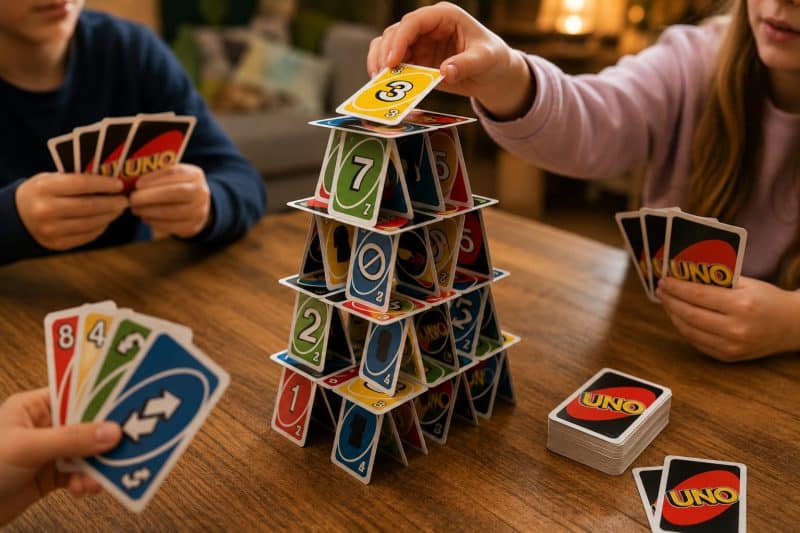
Uno Tower swaps strategy for steady hands! Instead of trying to get rid of your cards, you’re working together to build a tower using the Uno cards themselves. It sounds simple, but you’ll be surprised how tense it becomes as the tower gets taller and wobblier.
This is always a great ice-breaker at birthday parties or family gatherings because everyone can join in, whatever their age.
What you’ll need
- One standard Uno deck
- A flat table or floor
How to play
- Shuffle the deck.
- Place one card flat on the table as your base.
- Players take turns adding one card at a time to build the tower.
- You can make the game easier by placing cards flat, or harder by balancing them on their edges or creating small bridges between cards.
- If the tower collapses during your turn, you’re out of that round.
- The last player remaining is the winner.
Mummy Matters Tip
This is one of those games where everyone ends up laughing far more than they expect. We usually make it even funnier by giving the player who knocks the tower over a silly challenge, like singing a nursery rhyme, doing five star jumps or telling their best joke before the next round starts.
Family Challenge
Want to make it even harder?
Try one of these variations:
- 🏆 Build the tallest tower in five minutes.
- 🎨 Only place cards that match the colour underneath.
- 👆 Use just one hand.
- 🤫 Play in complete silence.
- 👨👩👧 Team adults versus children.
These little twists mean you can play the same game over and over without it feeling repetitive.
6. Sum It Up
Best for: Making maths practice fun
Players: 2–6
Recommended age: 6+ (or younger with adult help)
Playing time: Around 15 minutes
If you’re looking for a way to make maths feel less like homework, this is a brilliant game to try. Children are so busy concentrating on finding the right cards that they often don’t realise they’re practising mental addition at the same time.
It’s ideal for rainy afternoons, home learning or simply sneaking a little extra number practice into family games night.
What you’ll need
- One Uno deck
- Number cards only (remove all action and Wild cards)
How to play
- Shuffle the numbered cards and deal them evenly between the players.
- Decide on a target number, such as 10, 15 or 20.
- Players race to find two (or more) cards from their hand that add up to the target number.
- The first player to play a correct combination keeps a point.
- Draw replacement cards if needed and continue with a new target number.
- The player with the most points at the end wins.
Ways to make it easier or harder
- Younger children: Use smaller target numbers such as 5 or 10.
- Older children: Allow three-card combinations.
- Teenagers: Include subtraction or multiplication challenges.
- Adults: Set a timer to increase the pressure.
Mummy Matters Tip
This is one of my favourite educational games because it never feels like learning. If your child is reluctant to practise maths at home, introducing it as a game rather than a worksheet can make a huge difference.
7. Uno Reverse Challenge
Best for: Competitive families who love classic Uno
Players: 2–6
Recommended age: 7+
Playing time: Around 15 minutes
Reverse cards are often the most exciting part of a normal game of Uno, so why not make them the star of the show? This fast-paced variation keeps everyone on their toes as the direction of play changes constantly, making it much harder to plan your next move.
It’s a brilliant game if your family already knows the standard Uno rules but wants something that feels fresh.
What you’ll need
- One Uno deck
- Number cards and Reverse cards
- Remove Wild, Draw Two and Wild Draw Four cards
How to play
- Shuffle the deck and deal five cards to each player.
- Turn over the top card to start the discard pile.
- Players take turns matching either the colour or the number of the top card.
- Whenever a Reverse card is played, the direction of play immediately changes.
- If a player cannot play a matching card, they must draw one from the deck.
- The first player to get rid of all their cards wins.
Make it even more challenging
For older children and adults, add these optional house rules:
- If two Reverse cards are played back-to-back, the direction changes twice.
- If someone forgets the new direction, they must draw a penalty card.
- Play with a timer and allow only five seconds to make each move.
Mummy Matters Tip
Once everyone knows the rules, let the children invent one extra house rule of their own. We’ve found that children love putting their own stamp on games, and it often leads to the funniest family moments.
8. Uno Memory
Best for: Preschool and primary-aged children
Players: 2–4
Recommended age: 4+
Playing time: Around 10 minutes
This is one of the simplest ways to use an Uno deck with younger children. If you’ve ever played the traditional Memory game, the rules are almost identical, but the bright colours and large numbers on Uno cards make it especially appealing for little ones.
It’s also a lovely quiet activity when you want something calmer than competitive card games.
What you’ll need
- One Uno deck
- Number cards only
How to play
- Choose matching pairs of numbered Uno cards.
- Shuffle them thoroughly.
- Lay all the cards face down in neat rows.
- Players take turns turning over two cards.
- If the cards match, the player keeps the pair and takes another turn.
- If they don’t match, turn them face down again and the next player has a turn.
- When all the pairs have been found, count them up. The player with the most pairs wins.
Ways to adapt the game
As children become more confident, you can make the game harder by:
- adding more pairs
- mixing different coloured number cards
- setting a timer
- asking players to remember where specific colours are as well as numbers
Mummy Matters Tip
This is one of my favourite games to pack for holidays because it doesn’t need much space. We’ve played versions of this on camping trips, in holiday cottages and even while waiting for food in restaurants. It’s amazing how something so simple can keep children entertained.
9. Uno Colour Challenge
Best for: Younger children and quick family games
Players: 2–6
Recommended age: 4+
Playing time: Around 10 minutes
Looking for something really simple? Uno Colour Challenge is perfect for younger children who are still learning colours and taking turns. It requires very little setup, keeps everyone involved and is a brilliant choice when you only have ten minutes to spare.
It’s also a lovely game to play with preschoolers who aren’t quite ready for the full rules of Uno.
What you’ll need
- One standard Uno deck
- Number cards only
How to play
- Shuffle the numbered cards and place them face down in a pile.
- Decide who will go first.
- The first player turns over a card and places it in the middle.
- The next player must turn over a card of the same colour.
- If they can’t, they miss their turn.
- Continue until all the cards have been used.
- The player with the longest successful matching streak wins.
Fun variations
To make the game different each time, try:
- matching numbers instead of colours
- matching either colours or odd/even numbers
- racing against a timer
- playing in teams
Mummy Matters Tip
This is a great confidence-building game for younger children because there are no complicated rules to remember. It’s also ideal if older brothers or sisters want to join in, as they can help without taking over the game.
10. Create Your Own Uno House Rules
Best for: Families who have played Uno hundreds of times
Players: 2–10
Recommended age: 6+
Playing time: As long as you like!
Sometimes the most enjoyable version of Uno isn’t one you’ll find in the official rule book. Creating your own house rules is a brilliant way to keep the game feeling fresh, especially if your family already knows every card by heart.
The best house rules are simple enough for everyone to remember but different enough to make every game feel unpredictable.
Fun house rule ideas
Why not try one of these?
- Double Trouble – If you play two matching number cards together, the next player misses their turn.
- Lucky Seven – Anyone who plays a 7 swaps hands with another player.
- Colour Chaos – Whenever someone plays a card matching the previous colour, everyone must clap before play continues.
- Silent Uno – Forget to say “Uno” when you have one card left and you draw two extra cards.
- Family Choice – Before the game begins, let each player invent one new rule that everyone has to follow.
Create your own challenge
One of the things I love most about family games is that they don’t have to be played exactly as the instructions say. Some of our favourite moments have come from children inventing completely new rules that nobody expected. Not every idea works, but that’s all part of the fun!
Mummy Matters Tip
If you’re playing with children of different ages, invite everyone to suggest one house rule before the game starts. Younger children often come up with the funniest ideas, and involving everyone helps make family games feel more inclusive and memorable.
Looking for More Family Card Games to Try?

If your family has enjoyed trying these fun Uno games, why stop there? Card games are a fantastic way to spend quality time together, whether you’re planning a family games night, looking for screen-free entertainment during the school holidays or simply wanting something fun to pack for a camping trip or holiday.
You don’t need to spend a fortune to keep family games nights interesting either. We tend to build up our games collection gradually, adding something new when we spot a good offer rather than buying lots of games at once. If you’re planning to pick up a new board game, card game or family activity, it can be worth checking current deals and Wowcher discount codes before you buy.
As your children get older, you might find they enjoy exploring different styles of card games that introduce new characters, strategies and ways to play.
For those who enjoy collecting and playing card games, you might also want to explore collectable card games and purchase Lorcana cards online to expand your deck and enhance your gameplay experience.
Frequently Asked Questions
Can you play other games with Uno cards?
Absolutely! A standard Uno deck can be used to play lots of different games, including Uno Slap, Uno War, Uno Go Fish, memory games and educational maths games. With a few simple rule changes, one pack of Uno cards can provide hours of family entertainment.
Do you need a special Uno deck for these games?
No. Most of the games in this guide use a standard Uno deck. Some only require the numbered cards, while others use a few action cards such as Reverse cards to make the game more challenging.
Which Uno game is best for younger children?
For younger children, I’d recommend starting with Uno Memory, Uno Go Fish or the Uno Colour Challenge. They’re simple to learn, encourage turn-taking and help children practise recognising colours and numbers without feeling like they’re doing schoolwork.
Can two people play Uno games?
Yes! Although many Uno variations work well with larger groups, games like Uno War, Uno Tower and Uno Crazy Eights are all great fun with just two players.
Are Uno games good for family game nights?
Definitely. Uno is one of those rare games that works well across different age groups. Whether you’re playing with younger children, teenagers or grandparents, there are plenty of variations that everyone can enjoy together.
Can Uno help children learn?
Many of these games encourage children to develop important skills without realising they’re learning. Depending on the variation you choose, children can practise:
recognising colours
counting and simple maths
memory and concentration
taking turns
strategic thinking
communication and teamwork
Learning through play is often one of the most enjoyable ways for children to build confidence.
What age is Uno suitable for?
The official recommendation for classic Uno is usually 7 years and over, but many younger children can enjoy simplified versions with a little help from an adult. Games like Uno Memory and Uno Colour Challenge are particularly suitable for children aged four and above.
Which Uno variation is your family’s favourite?
If I had to choose just one, it would probably be Uno Slap. It’s fast, noisy and almost always ends with everyone laughing. For quieter moments, especially on holiday or while camping, Uno Memory is another favourite because it’s so easy to set up almost anywhere.
Don’t be afraid to mix and match the ideas above or invent completely new variations. Half the fun of Uno is creating family traditions that become unique to your household.
Conclusion
Ready to try something new with your Uno cards?
You don’t need a cupboard full of expensive board games to create lasting family memories. Sometimes all it takes is a well-loved Uno deck, a kitchen table and a little imagination.
Whether your family enjoys the fast-paced excitement of Uno Slap, the teamwork of Uno Tower or the quieter concentration needed for Uno Memory, these simple variations are a brilliant way to spend quality time together. They’re ideal for rainy afternoons, camping trips, family holidays or simply switching off the screens for an hour.
Why not try a different game each week and let everyone in the family vote for their favourite? You might just discover a new tradition that everyone looks forward to.
If you have your own favourite Uno variation or a house rule that’s become a family tradition, I’d love to hear about it. Leave a comment below and share your ideas—you might inspire another family to give it a try.
Editor’s Note: This article was fully updated in July 2026 to include new Uno game variations, improved instructions, age recommendations, family-friendly tips and answers to the most frequently asked questions, ensuring it remains a helpful resource for parents looking for fun screen-free activities.