

By the time August arrives, the excitement of the summer holidays can start to wear off. The list of places to visit has become shorter, the weather isn’t always playing ball, and it’s all too easy for phones, tablets and games consoles to become the default way to fill long afternoons.
There’s nothing wrong with enjoying a little screen time—after all, technology has its place in family life. But many parents reach a point where they realise everyone is spending more time looking at separate screens than making memories together.
That’s where screen-free family challenges can make all the difference.
Rather than focusing on strict rules or unrealistic expectations, these simple challenges encourage everyone in the family to join in. They’re designed to bring laughter, conversation and shared experiences back into everyday life, whether you have energetic young children, reluctant teenagers or a mix of ages under one roof.
Best of all, most of these ideas cost little or nothing to do. You don’t need expensive attractions or perfectly planned days—just a willingness to spend a little quality time together. You might even discover that some of your family’s favourite summer memories come from the simplest moments.
If you’re looking for fresh inspiration during the school holidays, these 20 screen-free family challenges are a fun way to reconnect, enjoy more meaningful time together and make the most of August before the new school term begins.
Why screen-free family challenges are worth trying

For many families, reducing screen time can feel like an uphill battle. Ask children to put their devices away and you’re often met with sighs, eye rolls or the familiar cry of “I’m bored!”
The difference with a family challenge is that it isn’t about taking something away – it’s about giving everyone something enjoyable to do instead. When parents join in too, the focus shifts from rules and restrictions to spending quality time together.
Screen-free family challenges can also help children develop important life skills without them even realising it. Depending on the activity, they may build confidence, improve communication, solve problems creatively or simply learn how to entertain themselves without relying on a screen.
For parents, these challenges offer a chance to slow down as well. Instead of rushing from one activity to the next or constantly checking notifications, you can enjoy conversations, laughter and those little everyday moments that often become the memories children treasure most.
The best part is that you don’t need to complete every challenge perfectly. Pick the ideas that suit your family, adapt them to your children’s ages and interests, and remember that the goal isn’t perfection—it’s creating more opportunities to connect before another busy school year begins.
Free August Screen-Free Family Challenge Tracker
Looking for a fun way to keep everyone motivated?
I’ve created this free printable August Screen-Free Family Challenge Tracker so your family can tick off each challenge as you complete it together. Pop it on the fridge, noticeboard or kitchen wall and see how many you can finish before the new school term begins.
The tracker includes all 20 challenges, a progress section, space to record your favourite summer memory and a special Challenge Champions certificate to celebrate your family’s achievements.
Click the image below to download your free printable.
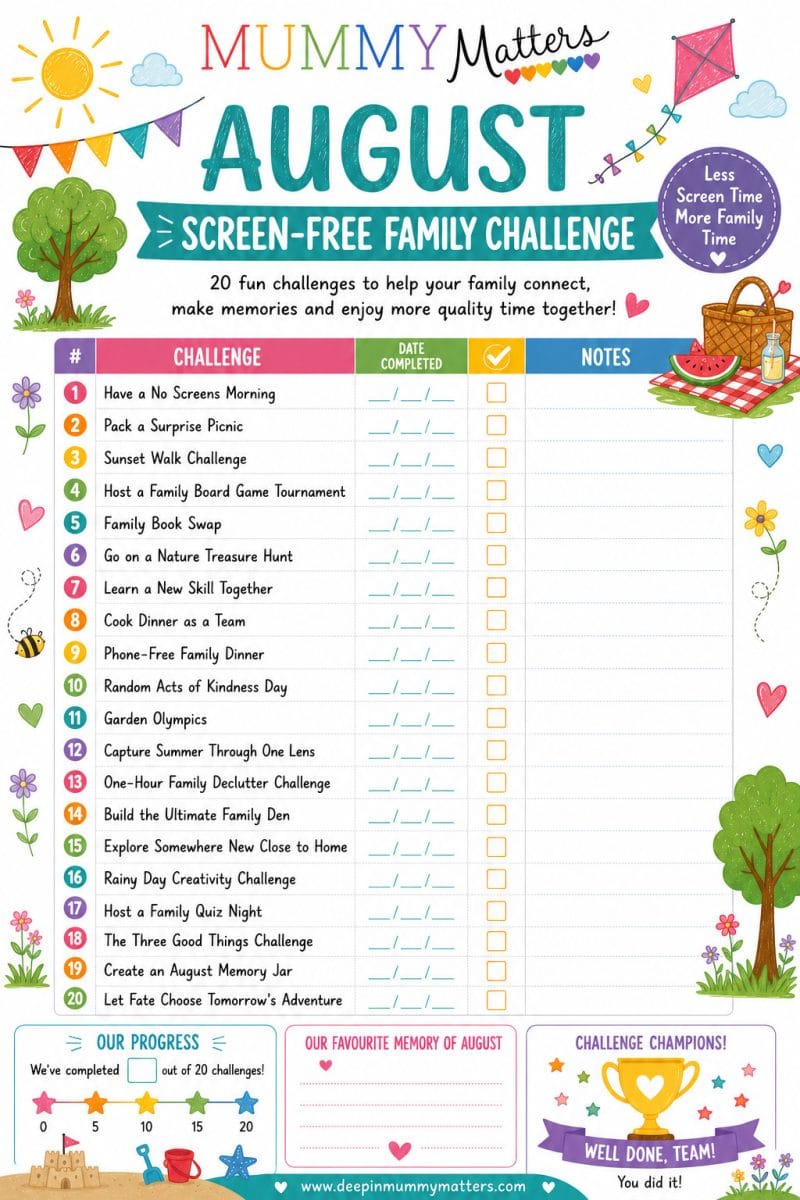
Top tip: Don’t worry if you don’t complete every challenge. The goal isn’t perfection—it’s making time for more laughter, conversations and shared memories together.
1. No Screens Until Lunch
If your mornings have started with everyone reaching for a phone, tablet or games console before they’ve even had breakfast, try introducing a “No Screens Until Lunch” challenge. Knowing that screen time isn’t completely off-limits later in the day can make this feel far less like a punishment, especially for older children and teenagers.
Instead, fill the morning with simple activities that encourage everyone to be present. You could enjoy a leisurely family breakfast, tackle a jigsaw puzzle, head into the garden, visit a local park, build with Lego, read a book or even bake something together for lunch. Younger children might enjoy crafts or imaginative play, while teenagers may be more willing to join in if they’re given some choice over the activity.
You don’t need to plan every minute. In fact, allowing a little boredom can be surprisingly beneficial. It gives children the chance to use their imagination, become more independent and discover new ways to entertain themselves.
By lunchtime, you’ll often find the family has already shared more conversations and laughter than they might have during an entire morning spent in separate rooms with separate screens.
Make it extra fun
Rather than announcing the challenge each morning, write different screen-free activities onto slips of paper and let one family member draw the morning’s activity from a jar. The element of surprise makes it feel like a game instead of a rule, and everyone gets involved in choosing what comes next.
2. Pack a Surprise Picnic
You don’t have to travel far or spend lots of money to make an ordinary day feel special. Challenge each family member to help pack a surprise picnic using whatever you already have at home, then head somewhere different to enjoy it. It could be your local park, a nearby nature reserve, the beach, a woodland trail or even just a blanket in the back garden.
To make it more interactive, ask everyone to contribute one item without telling the others what they’ve chosen. One person might bring fruit, another sandwiches, someone else drinks or a favourite treat. Younger children often love having responsibility for simple jobs, while teenagers may enjoy choosing the location or creating a playlist to listen to on the journey there.
The aim isn’t to create the perfect picnic worthy of social media—it’s about sharing an experience together away from screens and everyday distractions. Even a simple lunch outdoors often feels like a mini adventure, encouraging conversation and helping everyone slow down for a while.
Make it extra fun
Create a “picnic bingo” list before you leave. See who can spot a butterfly, hear birdsong, find a feather, spot five different coloured flowers or watch a squirrel. It’s a brilliant way to encourage everyone to notice the world around them instead of looking down at a screen.
3. Sunset Walk Challenge
There’s something wonderfully calming about heading out together as the day begins to wind down. Challenge your family to take an evening walk every day for a week, aiming to catch the sunset whenever possible.
You don’t need to cover miles or tackle a difficult hike. A gentle stroll around your neighbourhood, through the local park or along a nearby footpath is enough. Leave phones tucked away in pockets and use the time to chat about your day, share funny stories or play simple games like “I Spy” or “Would You Rather?”
For teenagers, walking side by side can often feel less intense than sitting face-to-face for a conversation. Without the pressure of eye contact, they may open up more naturally about school, friendships or anything that’s on their mind.
Even if the British weather doesn’t deliver a spectacular sunset every evening, the routine of getting outside together can quickly become one of the highlights of the summer holidays.
Make it extra fun
Let a different family member choose the route each evening. You could even keep a tally of the wildlife you spot or take one family photo at the end of each walk to create a simple August memories album.
4. Host a Family Board Game Tournament
Dust off your favourite board games and turn an ordinary afternoon or evening into a friendly family tournament. Choose a handful of games that suit everyone, whether it’s classics like Monopoly, Scrabble and Cluedo or quicker favourites such as Uno, Dobble or Exploding Kittens.
Create a simple scoreboard and award points for each game played throughout the week. You don’t have to crown the overall winner based purely on victories either. Give bonus points for good sportsmanship, helping younger players or making everyone laugh. This keeps the competition fun and inclusive rather than overly serious.
Board games naturally encourage communication, patience, problem-solving and teamwork, all while giving everyone a break from screens. They’re also a fantastic reminder that some of the best family memories are made sitting around the kitchen table with a few snacks and plenty of laughter.
Make it extra fun
Let the tournament winner choose a special family activity for the following day, such as picking the evening film, choosing dinner or deciding which challenge you’ll tackle next.
5. Family Book Swap
Reading doesn’t have to be a solitary activity. Challenge everyone to choose a favourite book, magazine or audiobook that they think another family member would enjoy and explain why they’ve picked it.
Younger children could choose a bedtime story to read together, while older children and teenagers might recommend a novel, graphic novel or even an interesting non-fiction book. Parents can join in too by sharing childhood favourites or books that have inspired them over the years.
At the end of the week, spend a little time chatting about what everyone enjoyed, what surprised them and whether they’d recommend it to someone else. It’s a lovely way to discover each other’s interests while encouraging a lifelong love of reading.
Make it extra fun
Create a cosy reading corner with blankets, cushions and hot chocolate, then enjoy an hour of quiet reading together before sharing your favourite parts.
6. Go on a Nature Treasure Hunt
Nature has a wonderful way of slowing us down and encouraging curiosity. Whether you’re exploring a local park, woodland, beach or simply wandering around your neighbourhood, challenge your family to spot as many interesting things as possible.
Your treasure hunt could include finding a feather, an acorn, a smooth pebble, something heart-shaped, a colourful butterfly, different bird species or leaves in a variety of shapes and sizes. Younger children will enjoy ticking items off a checklist, while older children might prefer photographing what they find using one shared family camera or phone.
This challenge encourages everyone to look up, pay attention to their surroundings and appreciate the little details that are often missed when we’re distracted by screens.
Make it extra fun
Before you set off, let each family member secretly add one unusual item to the treasure hunt list. It could be something like a tree with a hole in the trunk, a ladybird, a rainbow, a funny-shaped cloud or a flower they’ve never noticed before. Comparing who found each item adds an extra layer of excitement.
7. Learn a New Skill Together

Summer is the perfect time to try something completely different as a family. Instead of everyone learning separately, choose one new skill and have a go together. It doesn’t need to be complicated – the aim is to enjoy the process, not to become an expert overnight.
You could learn a few simple magic tricks, master basic origami, practise juggling with rolled-up socks, learn some beginner’s sign language, try calligraphy or even follow a beginner’s dance tutorial together. Teenagers might enjoy learning simple photography techniques or basic cooking skills, while younger children often love anything creative or hands-on.
Trying something new reminds children that it’s okay not to be perfect the first time. They see adults making mistakes too, which helps build resilience and confidence while creating plenty of opportunities for laughter along the way.
Make it extra fun
At the end of the week, host a mini “talent show” where everyone demonstrates what they’ve learned. Celebrate effort rather than perfection with homemade certificates or silly awards.
8. Cook Dinner as a Team
Instead of one person preparing dinner while everyone else disappears to their screens, turn mealtime into a family project. Choose a recipe together and give everyone an age-appropriate job, whether that’s washing vegetables, measuring ingredients, setting the table or stirring the sauce.
Cooking together teaches valuable life skills such as teamwork, planning and problem-solving, while also encouraging children to try new foods. Even reluctant eaters are often more willing to taste something they’ve helped prepare.
Don’t worry if the meal isn’t restaurant quality. Some of the funniest family memories come from slightly wonky pizzas, uneven cupcakes or recipes that didn’t quite go to plan. It’s the shared experience that matters most.
Make it extra fun
Let a different family member be “Head Chef” each week. Their job is to choose the recipe and delegate everyone’s tasks before sitting down to enjoy the finished meal together.
9. Phone-Free Family Dinner
How often does someone glance at a notification halfway through a meal? Challenge everyone – adults included – to leave their phones in another room while you eat together.
Without the usual distractions, conversations tend to flow much more naturally. Ask open-ended questions that encourage everyone to join in, such as:
- What made you laugh today?
- What’s one thing you’re proud of this week?
- If you could visit anywhere tomorrow, where would you go?
- What’s something new you’d like to learn before summer ends?
The challenge isn’t about banning technology forever. It’s simply about creating one part of the day where everyone is fully present with one another.
Make it extra fun
Place all phones in a basket before dinner. If someone reaches for theirs during the meal, they have to clear the table afterwards or choose tomorrow’s family challenge.
10. Random Acts of Kindness Day
Kindness is contagious, and summer is a wonderful time to spread a little happiness. Challenge your family to complete as many random acts of kindness as possible in a single day. They don’t have to be grand gestures—often it’s the smallest acts that make the biggest difference.
You could bake cakes for a neighbour, write thank-you notes to teachers before the new school year, donate toys or books you no longer use, help an elderly neighbour with their shopping, litter pick in your local park or leave a cheerful message with some chalk on the pavement outside your home.
As you go about your day, encourage everyone to notice how helping others makes them feel. Children quickly learn that kindness benefits both the person receiving it and the person giving it, making this challenge a meaningful way to spend time together.
Make it extra fun
Create a family kindness chart and see how many smiles you can spread before bedtime. At the end of the day, talk about which act of kindness felt the most rewarding and why.
11. Garden Olympics

Who says you need expensive equipment to have a brilliant afternoon? Transform your garden or a nearby green space into your own Olympic arena using items you already have at home.
Set up simple events such as an egg-and-spoon race, sack race, beanbag throw, obstacle course, skipping challenge, hula hoop competition or water balloon relay if the weather is warm. Adapt the activities to suit the ages and abilities of everyone taking part so that nobody feels left out.
Remember, the aim isn’t to discover the fastest or strongest family member. It’s about cheering one another on, laughing together and enjoying some healthy outdoor fun away from screens.
Make it extra fun
Hold a homemade opening ceremony complete with a family flag, funny team names and medals made from cardboard, ribbon or even biscuits. Don’t forget to celebrate everyone’s efforts with a closing ceremony too.
12. Capture Summer Through One Lens
Instead of everyone taking photos on their own phone, choose one shared camera or mobile phone and challenge the family to tell the story of your summer together.
Take turns being the official family photographer for the day, encouraging each person to capture moments that make them smile. It could be a funny face at breakfast, a beautiful flower on a walk, the family dog asleep in the sunshine or a spectacular sunset. By using just one device, everyone stays involved in the experience rather than disappearing behind separate screens.
At the end of August, look through the photos together and choose your favourites to print or turn into a simple scrapbook. Children often love seeing the holiday through someone else’s eyes, and you’ll end up with a collection of genuine family memories rather than hundreds of forgotten images hidden on different phones.
Make it extra fun
Choose one photo each day and ask everyone to give it a fun caption. You could even vote for categories such as “Funniest Moment”, “Best Nature Photo” or “Most Unexpected Picture” at the end of the month.
13. One-Hour Family Declutter Challenge
If your home feels as though it’s been taken over by toys, books, craft supplies and the general chaos that often comes with the school holidays, set a timer for just one hour and see what you can achieve together.
Choose one area of the house—a bedroom, the playroom, a cupboard or even the garage—and work as a team. Younger children can sort toys into “keep”, “donate” and “recycle” piles, while older children and teenagers can organise shelves, wardrobes or sports equipment.
Rather than making it feel like a chore, focus on how satisfying it is to create more space and help someone else by donating items you no longer need. Many charities are especially grateful for good-quality toys, books and games during the summer months.
Make it extra fun
Play upbeat music while you work and set mini challenges, such as “Who can fill a donation box first?” or “How many books can we organise in ten minutes?” When you’re finished, reward yourselves with a favourite snack or a family film later in the evening.
14. Build the Ultimate Family Den
Few activities spark imagination quite like building a den, and it isn’t just for younger children. Gather blankets, cushions, chairs, pegs and fairy lights, then work together to design the cosiest hideaway you can.
Your finished den could become a reading nook, a storytelling corner, a board game headquarters or even the venue for an indoor picnic if the weather takes a turn for the worse. Teenagers may pretend they’re too old at first, but many secretly enjoy getting involved once the creativity starts flowing.
Working together to solve little problems—like how to stop the roof falling down or where to create the entrance—encourages teamwork, communication and plenty of laughter.
Make it extra fun
Once your den is complete, ban screens for an hour inside. Instead, tell stories, play card games, read books aloud or enjoy hot chocolate together by torchlight for a cosy end to the day.
15. Explore Somewhere New Close to Home
You don’t have to travel hundreds of miles or spend a fortune to enjoy a family adventure. Challenge yourselves to visit somewhere you’ve never explored before within an hour of home.
It could be a country park, a village you’ve always driven through, a nature reserve, a heritage trail, a beach, a museum or a walking route you haven’t discovered yet. Give everyone a role for the day, such as navigator, photographer, picnic organiser or wildlife spotter, so that everyone feels involved.
Exploring somewhere unfamiliar reminds children that adventure doesn’t always mean going abroad. Often, some of the best family days out are waiting just around the corner.
Make it extra fun
Before you leave, each family member writes down three things they hope to discover. At the end of the day, compare your lists and see who spotted the most unusual sights, sounds or wildlife.
16. Rainy Day Creativity Challenge
Let’s face it—August in the UK doesn’t always guarantee sunshine. Instead of reaching for the TV remote when the rain starts, challenge your family to spend an afternoon creating something together.
Set up a craft station using whatever you already have at home. You could paint pebbles collected on a walk, make greeting cards, build a cardboard city, design your own board game or create a scrapbook filled with your favourite summer memories so far.
The goal isn’t to produce a masterpiece. Creativity encourages children to experiment, solve problems and express themselves, while giving everyone a chance to slow down and enjoy spending time together. You might even discover a new family hobby along the way.
Make it extra fun
Display everyone’s creations around the house and hold a mini art gallery at the end of the day. Each family member can explain the inspiration behind their masterpiece—no judging, just lots of encouragement and applause.
17. Host a Family Quiz Night

Turn an ordinary evening into a memorable event by creating your own family quiz night. Split into teams or play individually, with questions covering everything from music and films to geography, family memories and silly facts.
Invite everyone to contribute a few questions, including the children. Younger family members often come up with wonderfully unexpected rounds, while teenagers may enjoy testing everyone on current trends or favourite TV programmes.
You don’t need fancy equipment or prizes. A homemade trophy, bragging rights or choosing the next family activity is often enough to keep everyone motivated.
Make it extra fun
Include a mystery round where each family member brings an object from around the house. Everyone else has to guess who chose it and explain why. It always leads to interesting conversations and plenty of laughs.
18. The Three Good Things Challenge
Before bed each evening, gather together for just five minutes and invite everyone to share three things:
- Something that made them smile today.
- Something they’re proud of.
- Something they’re grateful for.
Some days the answers might be big milestones, while other days they may be as simple as spotting a rainbow, eating an ice cream or spending time together in the garden.
This gentle daily habit helps children develop gratitude, encourages positive conversations and reminds everyone to notice the little moments that can easily be overlooked during busy family life.
Make it extra fun
Write everyone’s answers on colourful slips of paper and keep them in a jar. By the end of August, you’ll have a wonderful collection of happy memories to read together.
19. Create an August Memory Jar
As summer begins to draw to a close, encourage every family member to write down one favourite memory from each day. Fold the notes and pop them into a large jar, box or tin.
Your memories don’t need to be extraordinary. They might be as simple as laughing during a board game, discovering a beautiful walk, sharing fish and chips by the seaside or watching a spectacular sunset together.
When the school holidays are over—or even on New Year’s Eve—empty the jar and read every memory aloud. It’s a lovely reminder that the moments children treasure most are often the ones that cost nothing at all.
Make it extra fun
Decorate your memory jar together using ribbons, stickers, paint or coloured paper so it becomes a keepsake you’ll enjoy bringing out every summer.
20. Let Fate Choose Tomorrow’s Adventure
Finish August with a challenge that keeps everyone excited about what’s coming next. Ask each family member to write down three simple activities they’d love to do, then fold the ideas and place them into a jar.
Each morning, choose one idea at random and make it your family adventure for the day. One slip might suggest flying a kite, another could be baking cupcakes, visiting a new park, playing football, building a den or enjoying a movie night after a screen-free afternoon.
By giving everyone an equal say, children are far more likely to feel involved and enthusiastic. It also removes the daily pressure of deciding what to do, as the jar makes the choice for you.
As August comes to an end, you’ll have enjoyed a wonderful mix of planned adventures, spontaneous fun and precious time together—proving that the best family memories are often created through the simplest ideas.
Make it extra fun
Keep adding new activity ideas throughout the year and bring the adventure jar out during weekends, half-term breaks and future school holidays whenever someone says, “I’m bored!”
Frequently Asked Questions
How can I encourage my children to spend less time on screens?
The most effective way to reduce screen time is to offer enjoyable alternatives rather than focusing on restrictions. Family walks, board games, baking, crafts and outdoor adventures all give children something positive to look forward to. Involving children in choosing activities can also make them more enthusiastic about taking part.
How much screen time is appropriate during the summer holidays?
There’s no single rule that works for every family. The key is finding a healthy balance between screen-based entertainment and other activities such as outdoor play, reading, creative hobbies, exercise and spending time together. Many families find it helpful to agree on simple screen time boundaries while still allowing flexibility for rainy days or special occasions.
What if my teenager doesn’t want to join in?
It’s perfectly normal for teenagers to want more independence, so avoid forcing them to take part in every challenge. Instead, invite them to help choose activities or give them responsibility for planning one of the family challenges. When teenagers feel their opinions are valued, they’re often much more willing to join in.
What are some inexpensive screen-free activities for families?
Many of the best screen-free activities cost little or nothing. Visiting a local park, having a picnic, building a den, playing board games, cooking together, going on a nature walk or creating a family quiz night are all affordable ways to spend quality time together.
What are the benefits of screen-free family activities?
Spending time away from screens gives families the chance to reconnect, communicate and create lasting memories. Screen-free activities can also encourage creativity, improve problem-solving skills, support children’s emotional wellbeing and provide opportunities for physical activity and relaxation.
Do screen-free challenges work for children of different ages?
Yes. The secret is to adapt each challenge to suit your family. Younger children may enjoy imaginative play and treasure hunts, while older children and teenagers often prefer helping to plan activities, cooking, photography or exploring somewhere new. Many of the ideas in this guide can easily be tailored so that everyone feels included.
Can screen-free activities still include technology?
Absolutely. The aim isn’t to avoid technology altogether but to use it more intentionally. For example, you might use one shared phone to take family photos, play music during a picnic or look up the name of a bird you’ve spotted on a walk. The focus is on using technology to enhance your time together rather than replace it.
Conclusion
The school summer holidays don’t have to be filled with expensive days out or perfectly planned activities to become unforgettable. In fact, it’s often the simplest moments that leave the biggest impression—laughing over a board game, building a den in the living room, sharing a picnic in the park or chatting during an evening walk.
These screen-free family challenges aren’t about banning technology or making parents feel guilty. They’re about creating small opportunities to slow down, reconnect and enjoy one another’s company before the busy routines of the new school term begin.
Don’t worry about completing all 20 challenges. Choose the ones that suit your family, adapt them to your children’s ages and interests, and remember that the goal is progress, not perfection. Even one or two screen-free afternoons each week can help create happier memories and stronger family connections.
Here’s to making the most of August—one challenge, one adventure and one special family moment at a time.
Before you go…
If you’re looking for even more inspiration to enjoy the school holidays together, you might also like these guides:
- 50 Free (or Cheap) Things to Do During the Summer Holidays – packed with budget-friendly ideas for days out and activities.
- Summer Screen Time Rules Without Arguments – practical ways to create healthier screen habits without daily battles.
- How to Be More Present During the Last Weeks of the Summer Holidays – simple ways to slow down and make the most of the time you have together.
Editor’s Note: We’ve tried several of these challenges as a family over the years, and it’s amazing how often the simplest ideas become the ones everyone remembers. Feel free to adapt the challenges to suit your children’s ages and interests—the goal isn’t perfection, it’s spending more quality time together.