

Updated for 2026
Running a business comes with countless responsibilities, and payroll is one task that simply can’t afford to go wrong. Employees expect to be paid accurately and on time, while businesses must ensure they’re meeting their legal obligations for tax, pensions and reporting. For many business owners, keeping on top of payroll quickly becomes more complicated than expected.
I discovered this first-hand when Mummy Matters began to grow, and I started taking on staff. Until then, payroll had never really been something I needed to think about. Once I became responsible for paying employees, however, I quickly realised there was far more involved than simply transferring wages into a bank account.
There were tax deductions, National Insurance contributions, pension requirements, statutory payments and reporting to HMRC to consider. Like many small business owners, I wanted to spend my time growing the business rather than worrying whether I had calculated somebody’s pay correctly or submitted the right information before a deadline.
That’s ultimately why I chose to outsource my payroll. It wasn’t because I couldn’t learn how to do it—it was because I recognised that specialists could do it far more efficiently and with far less risk of costly mistakes.
If you’re currently considering outsourcing payroll, this guide explains the features worth looking for, the questions you should ask potential providers and how to choose a service that will continue supporting your business as it grows.
Why businesses choose payroll outsourcing

For many businesses, payroll starts off relatively straightforward. A handful of employees can often be managed manually or with basic payroll software.
As a business expands, however, payroll becomes significantly more time-consuming.
You may need to manage:
- PAYE tax deductions
- National Insurance contributions
- Workplace pension auto-enrolment
- Statutory Sick Pay
- Statutory Maternity or Paternity Pay
- Holiday pay
- Overtime
- Bonuses and commissions
- Payroll reporting to HMRC
- Year-end reporting
- New starter and leaver documentation
Even one small error can create unnecessary administration or financial penalties.
Outsourcing payroll allows business owners to hand these responsibilities to specialists, freeing up valuable time while reducing compliance risks.
Many businesses manually handle these tasks in-house, but outsourcing these to a payroll management provider saves resources and time. If you’re comparing providers, it’s worth understanding what to look for in a payroll outsourcing partner before making your decision
My experience of outsourcing payroll
One thing I’ve learned from running my own business is that you can’t do everything yourself forever.
Like many small business owners, I wore every hat imaginable in the early days—content creator, accountant, administrator, customer service, marketing manager and everything in between. Payroll was simply another job on an already overflowing to-do list.
As soon as I employed staff, I realised I had reached a point where my time was better spent focusing on growing Mummy Matters than worrying about payroll deadlines and legislation.
I also knew there were areas where professional expertise mattered. Payroll legislation changes regularly, and I didn’t feel confident that I had enough knowledge to guarantee I was handling everything correctly.
Outsourcing payroll also meant I wasn’t worrying every payday whether I’d missed a deadline or misunderstood a regulation. That peace of mind alone made it worthwhile.
Instead of spending hours checking calculations or worrying about compliance, I knew experienced professionals were handling payroll accurately while I concentrated on running the business.
Looking back, it was one of those decisions that removed a significant amount of stress from my workload.
Top Tip
Don’t wait until payroll starts becoming overwhelming before looking at outsourcing. If you find yourself spending evenings checking calculations, worrying about HMRC deadlines or keeping up with changing legislation, it’s probably time to speak to a payroll specialist.
What does a payroll outsourcing service actually do?
As businesses grow, managing payroll in-house can become increasingly time-consuming. Many organisations choose to work with specialist Payroll services to reduce administration, improve accuracy and ensure they remain compliant with changing legislation. Whether you’re employing your first member of staff or managing a much larger workforce, outsourcing payroll can provide valuable peace of mind while freeing up time to focus on running your business.
This is a challenge faced by businesses across the UK. HMRC and the Office for National Statistics estimate there are around 30 million payrolled employees in the UK, all of whom rely on employers submitting accurate payroll information through the PAYE system.
In reality, most modern payroll outsourcing services offer a much wider range of support.
Depending on the provider you choose, they may handle:
- Calculating employee wages and salaries
- Processing overtime, bonuses and commissions
- Managing PAYE tax deductions
- National Insurance calculations
- Workplace pension contributions
- Statutory payments
- Producing payslips
- Direct deposits or BACS payments
- HMRC reporting
- Year-end payroll submissions
- Employee self-service portals
- Payroll reporting
- Holiday and absence tracking
- Secure employee record management
Many providers also integrate directly with popular accounting software, reducing duplicate administration and helping business owners keep accurate financial records.
Benefits of outsourcing payroll
Every business is different, but there are several reasons why payroll outsourcing has become increasingly popular.
Saves valuable time
Payroll is repetitive but incredibly important.
Even for a small business, processing payroll every month can take several hours.
When you’re already juggling sales, marketing, customer service and day-to-day operations, those hours quickly add up.
Outsourcing allows you to focus on activities that actually grow your business.
Reduces costly mistakes
Payroll errors can be expensive.
Incorrect tax deductions, pension contributions or employee payments often require significant time to correct and may even result in penalties.
An experienced payroll provider follows established processes designed to minimise these risks.
Keeps your business compliant
Employment legislation evolves regularly.
Professional payroll providers monitor changes in tax rules, reporting requirements and workplace legislation to help businesses remain compliant.
This can be particularly valuable for small businesses without dedicated HR or finance departments.
Gives employees a better experience
Employees expect to receive accurate payslips and prompt salary payments.
Reliable payroll contributes to trust and professionalism within your organisation.
Many providers also offer employee self-service portals where staff can securely access payslips, tax documents and payroll information without contacting HR.
Can save money
Although payroll outsourcing comes with a cost, it often represents excellent value when compared with:
- staff time
- training
- payroll software
- correcting mistakes
- potential penalties
- ongoing compliance
For many businesses, outsourcing becomes more cost-effective than managing payroll internally.
Choosing the right payroll outsourcing partner

Deciding to outsource payroll is only the first step.
Choosing the right provider is equally important.
There are countless payroll companies available, from local specialists to large national providers and cloud-based payroll platforms.
It’s worth taking the time to compare your options carefully before making a decision.
One useful starting point is understanding how to choose the best payroll outsourcing partner for your business, as different providers offer varying levels of support, technology and expertise.
Similarly, providers such as My Payroll Outsourcing demonstrate how different payroll companies tailor their services to businesses of different sizes and industries.
Rather than choosing purely on price, look at the overall value each provider offers and whether their services align with your business’s current and future needs.
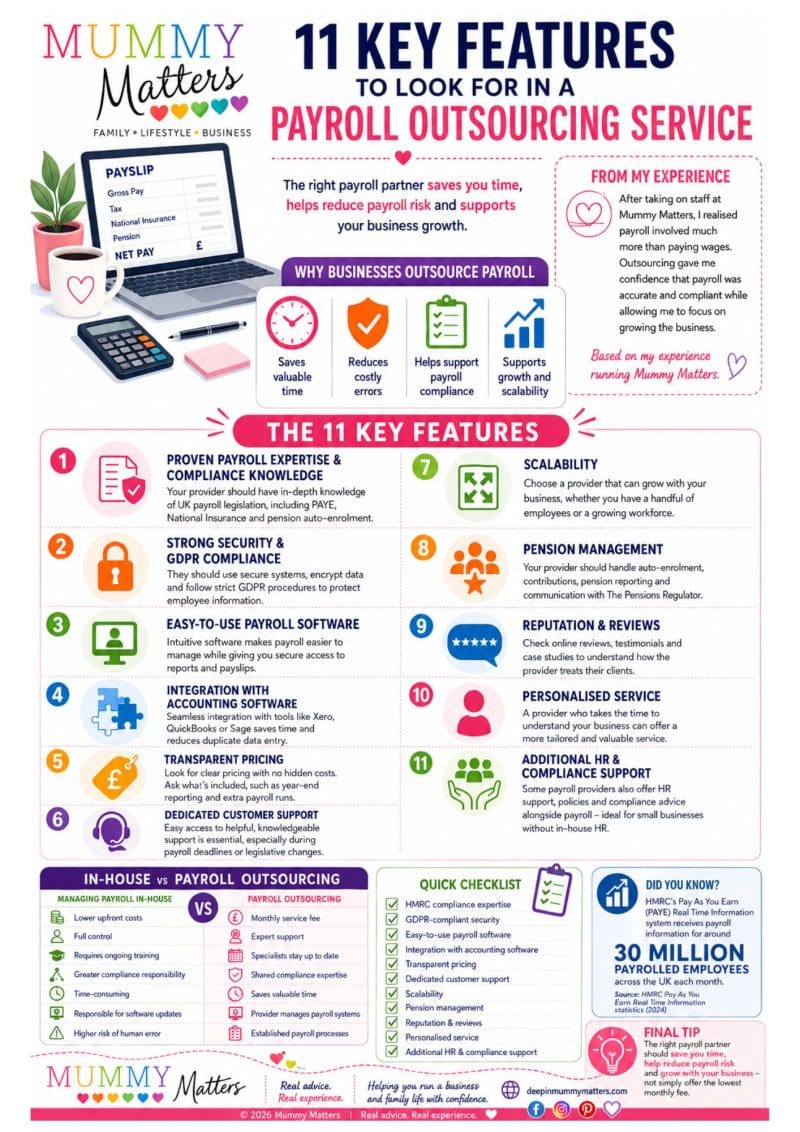
11 Key Features to Look for in a Payroll Outsourcing Service
No two payroll providers are exactly the same. While most offer the core functions of processing employee pay and submitting payroll information, the level of service, technology and support can vary considerably.
Before choosing a provider, I recommend comparing them against the following features rather than focusing solely on price.
1. Proven payroll expertise and compliance knowledge
Payroll legislation changes regularly, and staying compliant is one of the biggest reasons businesses choose to outsource in the first place.
A reputable payroll provider should have extensive knowledge of:
- PAYE
- National Insurance
- Workplace pension auto-enrolment
- Statutory Sick Pay (SSP)
- Statutory Maternity, Paternity and Adoption Pay
- HMRC reporting requirements
- Year-end payroll obligations
Rather than expecting you to keep up with changing legislation, your provider should monitor updates and apply them as part of their service.
Ask prospective providers how they stay up to date with legislative changes and what systems they have in place to ensure compliance.
2. Strong security and GDPR compliance
Payroll contains some of the most sensitive information your business holds.
Employee records typically include:
- names and addresses
- National Insurance numbers
- salary details
- bank account information
- tax records
- pension contributions
For that reason, data security should never be an afterthought.
Ask potential providers:
- How is payroll data encrypted?
- Where is employee data stored?
- Are regular security updates performed?
- How often are systems backed up?
- What happens if there’s a cyber attack?
- How quickly can data be restored?
Given the increasing number of cyber security threats facing businesses today, it’s reassuring to know your payroll provider has robust security procedures in place.
3. Easy-to-use payroll software
The best payroll outsourcing providers don’t just process payroll—they also provide intuitive software that makes managing your workforce much easier.
Look for features such as:
- employee self-service portals
- online payslips
- holiday tracking
- absence management
- secure document storage
- downloadable payroll reports
- mobile access
If possible, request a demonstration before committing.
Even though specialists will manage much of the work, you’ll still want a platform that’s straightforward to use whenever you need to access employee information.
4. Integration with your accounting software
One feature that’s often overlooked is software integration.
If your payroll system connects directly with your accounting software, it can significantly reduce administration.
For example, integrations may automatically transfer:
- payroll journals
- pension contributions
- tax liabilities
- employee costs
- financial reports
This reduces duplicate data entry and helps keep financial records accurate.
If you already use accounting software such as Xero, QuickBooks or Sage, ask whether the payroll provider integrates with your existing systems.
5. Transparent pricing
Payroll providers use different pricing structures.
Some charge:
- per employee
- per payroll run
- monthly subscription
- annual contracts
Others may charge additional fees for:
- year-end processing
- pension administration
- HMRC submissions
- new starters
- employee leavers
- bespoke reporting
Always request a full breakdown of costs before signing a contract.
The cheapest provider isn’t necessarily the best value if you’re constantly paying for extras that weren’t included in the original quote.
6. Dedicated customer support
One lesson I’ve learned through running my own business is that good customer support is invaluable.
If payroll goes wrong the day before employees are due to be paid, you don’t want to spend an hour sitting in a telephone queue speaking to different people every time.
Instead, look for providers that offer:
- a dedicated account manager
- telephone support
- email support
- live chat
- clear response times
- emergency assistance for urgent payroll issues
Having a familiar point of contact who understands your business can make resolving queries much quicker and far less stressful.
Top Tip
Always ask whether year-end reporting, pension administration and additional payroll runs are included before comparing prices. The cheapest quote isn’t always the best value once extra charges are added.
7. Scalability as your business grows
The payroll solution that works for five employees may not be suitable once you have fifty.
Think beyond your immediate needs.
Ask whether the provider can support:
- business growth
- seasonal staff
- remote employees
- multiple pay frequencies
- multiple locations
- contractors
- directors’ payroll
Changing payroll providers later can be disruptive, so it’s worth choosing one capable of growing alongside your business.
8. Pension management
Since workplace pension auto-enrolment became mandatory, pension administration has become another important payroll responsibility.
A good payroll outsourcing provider should help with:
- pension enrolment
- contribution calculations
- pension reporting
- employee communications
- re-enrolment requirements
Handling pensions correctly reduces administration while helping ensure ongoing compliance.
9. Reputation and client reviews
Before making a decision, spend some time researching the provider’s reputation.
Read independent reviews rather than relying solely on testimonials published on the company’s own website.
You could also ask:
- How long have they been operating?
- What industries do they specialise in?
- Can they provide client references?
- What is their client retention rate?
- Do they work with businesses similar to yours?
Choosing an experienced provider with a strong reputation often provides greater peace of mind than selecting the lowest-cost option.
10. A personalised service
Every business operates differently.
Some companies have salaried staff, others employ hourly workers, contractors or seasonal employees.
The best payroll providers take time to understand your business rather than offering a one-size-fits-all solution.
Look for a provider that asks questions about:
- your workforce
- your payroll schedule
- your accounting systems
- your future plans
- your reporting requirements
- your preferred way of working
That personalised approach often results in a much smoother long-term partnership.
11. Additional HR and Compliance Support
Many companies, particularly small businesses, don’t have HR departments, and some don’t have an in-house HR person. The work is often performed by the business leader, who typically wears a few hats. Adhering to regulations is time-consuming and complex. For businesses finding that employee administration and workplace compliance are becoming difficult to manage internally, small business HR outsourcing can provide broader support alongside an outsourced payroll provider.
On most days, business owners may need to:
- Comply with employment regulations and correctly classify employees.
- Report new starters where required.
- Meet workplace pension obligations.
- Maintain accurate employee records.
- Keep up to date with National Minimum Wage and National Living Wage changes.
- Ensure employees have the correct right to work documentation where applicable.
Working with an experienced payroll provider means many of these responsibilities are monitored alongside payroll processing, helping reduce administrative pressure while supporting ongoing compliance.
Payroll Outsourcing Checklist
Before making your final decision, use this quick checklist.
| Feature | ✔ |
|---|---|
| HMRC compliance expertise | ☐ |
| GDPR-compliant security | ☐ |
| Employee self-service portal | ☐ |
| Dedicated account manager | ☐ |
| Transparent pricing | ☐ |
| Pension management | ☐ |
| Software integrations | ☐ |
| Excellent customer reviews | ☐ |
| Scalable services | ☐ |
| Reliable customer support | ☐ |
| Additional HR & compliance support | ☐ |
If a provider can confidently tick every box, there’s a good chance they’ll be a strong fit for your business.
Payroll Outsourcing vs Payroll Software: Which Is Right for Your Business?
One of the biggest questions business owners face is whether they actually need a payroll outsourcing service or whether payroll software alone will do the job.
The answer depends on the size of your business, your confidence in managing payroll and how much time you can realistically dedicate to it.
Payroll software can certainly make payroll easier, but it’s important to remember that software is only a tool. You’re still responsible for entering the correct information, checking calculations, staying up to date with legislation and ensuring payroll is submitted accurately and on time.
A payroll outsourcing provider, on the other hand, combines software with professional expertise. Rather than simply giving you the tools, they take responsibility for processing payroll correctly and helping you stay compliant.
Payroll Software
Best suited to:
- Sole traders beginning to employ staff
- Very small businesses with simple payroll needs
- Business owners who are confident managing payroll legislation
Advantages
- Lower monthly costs
- Greater control over payroll
- Immediate access to payroll data
- Flexible reporting
Things to consider
- You remain responsible for compliance
- Payroll legislation changes must be monitored by you
- Errors can become expensive
- Processing payroll still takes time every month
Payroll Outsourcing
Best suited to:
- Growing businesses
- Companies with multiple employees
- Business owners with limited time
- Organisations wanting additional peace of mind
Advantages
- Specialists manage payroll for you
- Reduced administration
- Greater confidence in compliance
- More time to focus on running your business
- Ongoing professional support
Things to consider
- Higher monthly cost than software alone
- Less direct involvement in day-to-day processing
- Choosing the right provider is essential
For many small businesses, the additional cost of outsourcing is often outweighed by the time saved and the reassurance that payroll is being handled professionally.
Common Mistakes to Avoid When Choosing a Payroll Provider

Not every payroll service offers the same level of support, and choosing purely on price can sometimes prove expensive in the long run.
Here are some of the most common mistakes business owners make.
Choosing the cheapest provider
It can be tempting to compare providers solely on monthly cost.
However, lower fees may come with:
- limited customer support
- hidden charges
- outdated software
- fewer payroll services
- slower response times
Instead of asking, “Who is cheapest?”, ask, “Who offers the best value for my business?”
Not checking customer support
Payroll problems rarely happen at convenient times.
Before signing up, find out:
- How quickly are calls answered?
- Is email support available?
- Can you speak to the same adviser?
- Is support available outside normal office hours?
- Is emergency assistance offered?
Reliable customer support often becomes invaluable when unexpected issues arise.
Ignoring security
Payroll contains highly confidential employee information.
Before committing, ask about:
- data encryption
- cybersecurity measures
- GDPR compliance
- secure backups
- disaster recovery procedures
Protecting employee information should always be a priority.
Failing to think long term
Many businesses choose a provider based solely on their current needs.
Instead, think ahead.
If your business doubles in size over the next few years, will your payroll provider still be able to support you?
Choosing a scalable solution now can save considerable disruption later.
Not understanding exactly what’s included
Some payroll providers include a comprehensive service.
Others charge extra for:
- year-end reporting
- pension administration
- additional payroll runs
- employee changes
- payroll reports
Always ask for a clear list of what’s included before signing any agreement.
Questions to Ask Before Signing a Contract

Meeting a potential payroll provider is the perfect opportunity to ask detailed questions.
Consider asking:
- How long have you been providing payroll services?
- Do you specialise in businesses of my size?
- What payroll software do you use?
- Can your system integrate with my accounting software?
- How do you protect sensitive employee data?
- Will I have a dedicated account manager?
- How are payroll deadlines managed?
- What happens if an error occurs?
- Are there any additional charges I should be aware of?
- How easy is it to leave if my circumstances change?
A reputable provider should be happy to answer these questions openly and transparently.
Before You Decide
Never choose a payroll provider based on price alone. Compare their expertise, customer support, security measures, software integrations and scalability to make sure they’re the right fit for your business both now and in the future.
When Is the Right Time to Outsource Payroll?
There’s no perfect number of employees that automatically means you should outsource payroll.
Instead, it’s usually a combination of factors.
You might benefit from outsourcing if:
- Payroll is taking up too much of your time.
- You’re unsure about current payroll legislation.
- You’re worried about making costly mistakes.
- Your workforce is growing.
- You’re spending evenings or weekends processing payroll.
- You don’t have dedicated HR or finance support.
- You’d rather focus on growing your business.
For me, the decision came when I realised my time was better invested elsewhere.
Running Mummy Matters already involved juggling content creation, client work, admin and business development. Payroll became another specialist task that I simply didn’t have the time—or confidence—to manage as well as a professional could.
Looking back, outsourcing payroll wasn’t about giving up control; it was about recognising that some parts of running a business are better handled by experts. It freed up valuable time and removed the worry that I’d overlooked an important deadline or misunderstood changing legislation.
Quick Comparison: Managing Payroll Yourself vs Outsourcing
| Managing Payroll In-House | Payroll Outsourcing |
|---|---|
| Lower upfront costs | Monthly service fee |
| Full control | Expert support |
| Requires ongoing training | Specialists stay up to date |
| Greater compliance responsibility | Shared compliance expertise |
| Time-consuming | Saves valuable time |
| Responsible for software updates | Provider manages technology |
| Higher risk of human error | Established payroll processes |
For many growing businesses, outsourcing becomes less about convenience and more about investing in accuracy, efficiency and peace of mind.
Frequently Asked Questions About Payroll Outsourcing
What is payroll outsourcing?
Payroll outsourcing is the process of hiring a specialist company to manage payroll tasks on your behalf. Depending on the service you choose, they may calculate employee wages, process tax and National Insurance deductions, manage workplace pensions, produce payslips and submit payroll information to HMRC. Outsourcing can help businesses save time, reduce administration and minimise the risk of payroll errors.
Is payroll outsourcing suitable for small businesses?
Yes. Many small businesses choose to outsource payroll because they don’t have dedicated HR or finance teams. Rather than spending valuable time learning payroll legislation and keeping up with changing regulations, business owners can focus on running and growing their business while specialists manage payroll accurately and efficiently.
Is payroll outsourcing secure?
Reputable payroll providers use secure systems to protect sensitive employee information. Before choosing a provider, ask about their data encryption, GDPR compliance, backup procedures and cybersecurity measures. A trustworthy provider should be transparent about how they protect payroll data.
How much does payroll outsourcing cost?
Costs vary depending on the provider and the size of your business. Some companies charge a fixed monthly fee, while others charge per employee or per payroll run. Additional services such as pension administration or year-end reporting may incur extra costs, so always request a detailed quotation before signing a contract.
Can payroll providers work with my accounting software?
Many payroll outsourcing companies integrate with popular accounting platforms such as Xero, QuickBooks and Sage. These integrations can reduce manual data entry and help keep your financial records up to date. Before choosing a provider, check whether they support the software you already use.
What’s the difference between payroll software and payroll outsourcing?
Payroll software gives you the tools to process payroll yourself, while payroll outsourcing involves experienced professionals managing payroll on your behalf. Software can be a good option for businesses with straightforward payroll needs, but outsourcing is often preferable for growing businesses that want expert support and greater peace of mind.
Final Thoughts
Payroll may never be the most exciting part of running a business, but it’s one of the most important.
Getting payroll right isn’t just about paying employees on time. It’s about meeting your legal obligations, protecting your business and giving your team confidence that they’re being paid accurately every pay period.
For me, outsourcing payroll became a sensible business decision once Mummy Matters grew and I started employing staff. It allowed me to spend less time worrying about legislation, deadlines and calculations, and more time focusing on developing my business.
If you’re considering payroll outsourcing, don’t simply compare providers on price. Look at the quality of customer support, the technology they use, their security measures and their ability to grow alongside your business. Taking a little extra time to choose the right provider now can save you considerable time, stress and money in the future.