
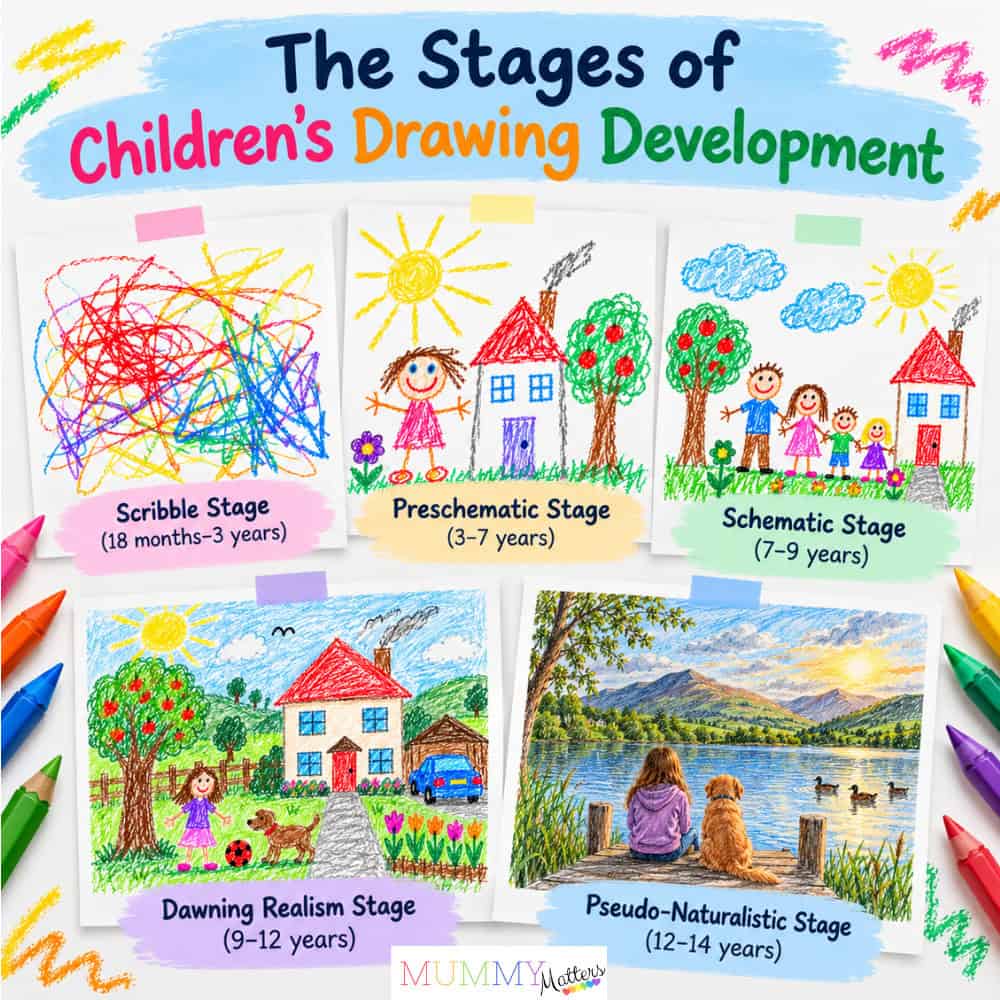
Children’s drawings change as they grow, from their first enthusiastic scribbles to recognisable people, animals and eventually more detailed pictures. These changes are often described as the stages of drawing development, and they can offer an interesting glimpse into how children explore shapes, develop hand control and express their ideas.
In this guide, we’ll explore the main stages of children’s drawing development, including the scribble, preschematic, schematic and pseudo-naturalistic stages. We’ll look at the approximate ages associated with each stage, what you might notice in your child’s artwork and simple ways to encourage their creativity.
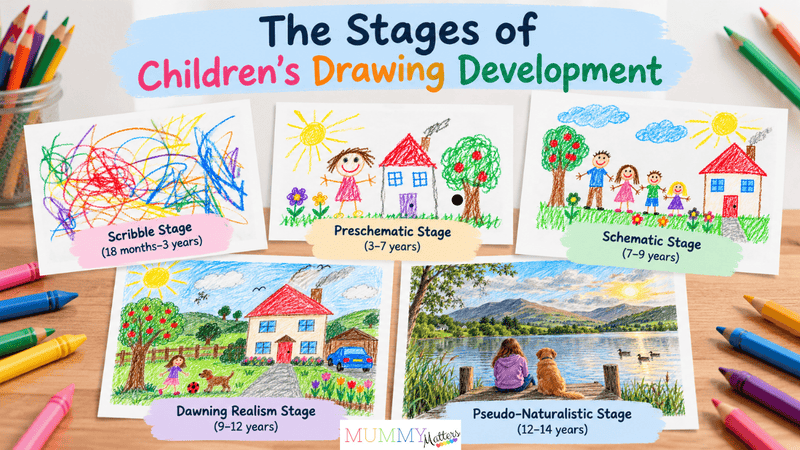
Every child develops differently, and drawing abilities can vary considerably depending on their interests, experiences and opportunities to practise. The stages are useful guides rather than strict milestones, and a child’s drawing ability alone cannot tell us whether their development is on track.
Children’s Drawing Development Stages by Age
| Drawing stage | Approximate age | What you might notice |
|---|---|---|
| Scribble stage | 18 months–3 years | Random marks gradually develop into more controlled lines, circles and scribbles. |
| Preschematic stage | 3–7 years | Children begin drawing recognisable people, animals and objects, often using simple shapes. |
| Schematic stage | 7–9 years | Drawings become more organised, with familiar patterns, repeated symbols and clearer relationships between objects. |
| Dawning realism | 9–12 years | Children become more interested in details, proportions and making their drawings look realistic. |
| Pseudo-naturalistic stage | 12–14 years | Some children experiment with perspective, shading, proportions and more realistic representations. |
These are approximate age ranges from traditional artistic-development frameworks, not NHS developmental milestones. Children may progress differently, and their interests, opportunities and individual abilities all influence their drawings.
The Scribble Stage (Approximately 18 Months–3 Years)
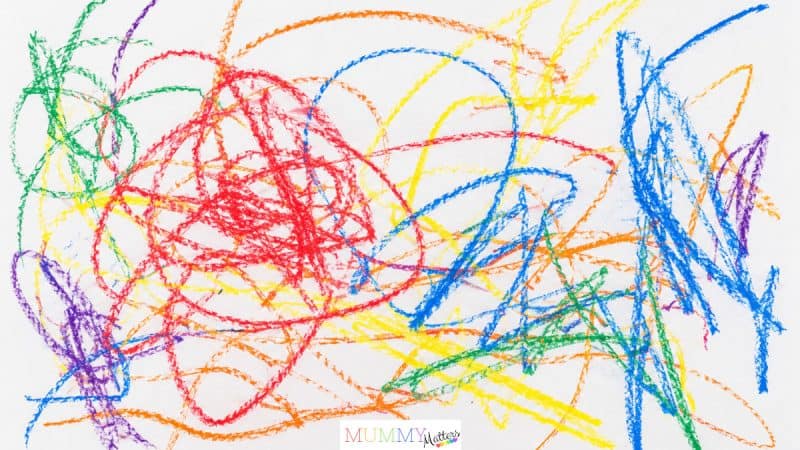
The scribble stage is often a child’s first experience of drawing, usually beginning at around 18 months, although some children start earlier or later. At first, they may grip a crayon in their fist and make seemingly random marks across the paper. As their hand control develops, these marks often become more deliberate, with repeated lines, circular movements and different patterns appearing.
Although these early drawings might not look like recognisable pictures, scribbling gives children opportunities to explore cause and effect, practise hand-eye coordination and develop fine motor skills. It’s an enjoyable part of early childhood development, rather than something that needs to be taught or assessed.
How to Encourage Drawing During the Scribble Stage
At this age, drawing is about exploring and having fun rather than producing recognisable pictures. There are plenty of simple ways to encourage your child’s interest without putting pressure on them.
- Offer chunky crayons and large sheets of paper. These can be easier for little hands to manage and give children plenty of room to experiment with different movements.
- Let them explore different marks. Encourage your child to make dots, straight lines and circular scribbles, but don’t worry if they prefer to make their own patterns.
- Try drawing on different surfaces. Making marks in sand with a finger, drawing with water and a paintbrush outdoors, or using washable crayons on paper can provide different sensory experiences.
- Talk about what they’re doing. You might say, “You’ve made lots of big circles!” rather than asking what their picture is supposed to be.
- Avoid correcting their drawings. Scribbling is an opportunity to experiment, and children don’t need their marks to look a particular way.
As children gain confidence and control, you may notice them repeating particular shapes or giving meaning to their scribbles. These can be early signs of more representational drawing, although every child develops at their own pace.
If you’re concerned about your child’s hand skills or wider development, speak to your health visitor or GP for advice. A child’s drawings alone cannot reliably identify a developmental difficulty.
The Preschematic Stage (Approximately 3–7 Years)
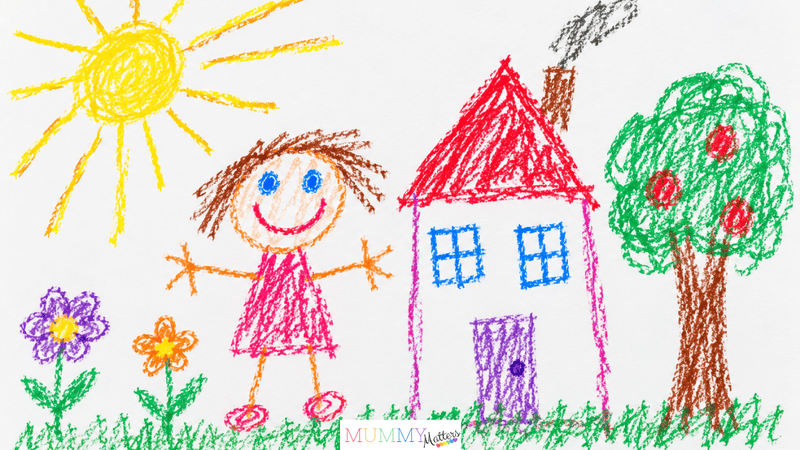
The preschematic stage is when children’s drawings begin to represent recognisable people, animals and objects rather than simply exploring marks on paper. This often develops during the preschool and early primary school years, broadly between ages three and seven, although the timing varies considerably between children.
You might notice your child drawing a person as a large circle with lines for arms and legs, sometimes called a ‘tadpole person’. Houses, trees, animals and family members may also begin to appear in their pictures. Colours and proportions aren’t necessarily realistic, and children often draw things according to what matters to them rather than how they look in real life.
As children become more confident, their drawings may include additional details, such as eyes, hair, fingers or clothing. These changes can be interesting to observe, but they aren’t a checklist of skills that every child should demonstrate by a particular birthday.
How to Encourage Drawing During the Preschematic Stage
As children begin drawing recognisable people, animals and objects, the best way to support their creativity is to give them opportunities to experiment without worrying about making their pictures look perfect.
Here are some simple activities to try:
- Draw familiar people and places. Invite your child to draw their family, pets, home or favourite playground. Let them decide what to include rather than directing every detail.
- Explore different art materials. Offer crayons, coloured pencils, washable paints and different sizes of paper to help children experiment with colours, shapes and textures.
- Tell stories through pictures. Ask your child to tell you about their drawing. They might create a picture of a family outing, an imaginary animal or something that happened at nursery or school.
- Experiment with shapes. Try drawing circles, squares and triangles together, then see how they can become houses, animals or other familiar objects.
- Display their artwork. Putting a favourite picture on the fridge or creating a small art gallery at home can show your child that you value their creativity.
What Can Children’s Drawings Tell Us at This Stage?
During the preschematic stage, you may notice children becoming more confident in using shapes and symbols to represent their ideas.
For example, a child might draw everyone in their family using the same basic figure but make one person much larger because they’re particularly important in the picture.
Drawings can provide interesting opportunities for conversation, but it’s important not to assume that the size, colours or details of a picture reveal a child’s emotions, intelligence or developmental abilities.
Rather than interpreting the drawing for them, try asking open-ended questions such as “Can you tell me about your picture?” or “What’s happening here?”
Remember that children develop drawing skills at different rates, and some simply enjoy drawing more than others.
How Drawing Supports Fine Motor Skills and Hand-Eye Coordination
Drawing gives children opportunities to practise the small hand and finger movements needed for everyday activities such as using cutlery, fastening buttons and eventually writing. For more information about how children’s hand skills develop through play and everyday activities, the NHS provides practical guidance on getting ready to write.
As children experiment with crayons, pencils and paintbrushes, they can develop greater control over their movements and begin coordinating what they see with what their hands are doing.
Drawing Activities That Help Develop Hand Skills
There are plenty of simple activities that can support these skills through play:
- Drawing on large sheets of paper: Gives younger children room to experiment with bigger arm movements before developing more controlled marks.
- Using chunky crayons: Can make mark-making more accessible for children who find smaller pencils difficult to hold.
- Drawing on vertical surfaces: Using an easel or paper attached to a wall can encourage different arm and wrist movements.
- Tracing shapes with fingers: Making circles, lines and patterns in sand, flour or water provides opportunities to explore movements without needing a pencil.
- Playing with different materials: Painting, colouring and experimenting with chalk offer varied ways to practise hand control.
Children don’t need to complete formal drawing exercises to develop these skills. Enjoyable, age-appropriate play is often a better starting point, particularly for younger children. If you’d like more ideas for supporting your child’s physical development through everyday play, take a look at our tips for building your toddler’s fine and gross motor skills.
When Might a Child Need Additional Support?
Children develop fine motor skills at different rates, and some may find drawing more challenging or less enjoyable than others.
If your child consistently struggles with everyday hand-based activities, experiences discomfort when drawing or seems frustrated by tasks involving hand control, consider speaking to their health visitor, GP or school.
Drawing ability alone isn’t enough to identify a developmental difficulty. Any concerns should be considered alongside your child’s wider development and everyday experiences.
How Drawing Supports Children’s Thinking and Social Development
Drawing isn’t just about developing artistic skills. It can also give children opportunities to explore ideas, express themselves and share experiences with others.
Whether they’re scribbling with crayons, drawing their family or creating an imaginary world, children can use pictures to communicate things that matter to them.
Encouraging Creativity and Problem-Solving
Drawing allows children to experiment with shapes, colours and different ways of representing the world around them.
For example, a child drawing a house might work out how to position the windows and doors, while another might invent an imaginary animal using shapes they’ve already learnt to draw.
These activities provide opportunities to practise planning, making choices and trying different approaches.
Using Drawing to Communicate and Connect
For some children, drawing can be an enjoyable way to share experiences or ideas that they find difficult to explain in words.
A child might draw a family outing, their favourite animal or something that happened at school.
Looking at pictures together can encourage conversations, storytelling and shared attention. Sharing drawings and talking about them can also create opportunities for children to practise communication and interaction. For more ideas, explore our examples of social development in early childhood.
You could try asking:
- “Can you tell me about your picture?”
- “What was your favourite part to draw?”
- “What do you think might happen next?”
- “Would you like to tell me who is in your drawing?”
There isn’t always a hidden meaning behind a child’s choice of colours, shapes or subjects. Sometimes children simply enjoy experimenting or drawing something they like.
Drawing together can be a relaxed way to spend time with your child.
You could create a picture together, take turns adding details to an imaginary creature or draw something you’ve seen during a family walk.
The aim isn’t to produce a perfect picture but to enjoy creating something together.
Children who don’t particularly enjoy drawing can explore creativity through painting, modelling clay, building activities or other forms of play.
Can Children’s Drawings Tell Us About Their Development?
Children’s drawings can offer interesting insights into how they represent the world, use shapes and express their ideas. However, it’s important not to read too much into an individual picture.
A child’s drawing may be influenced by their age, interests, confidence, previous experience, the materials available and whether they enjoy drawing.
How Occupational Therapists and Art Therapists Can Help
Occupational therapists may consider drawing and other activities involving hand control when assessing a child’s fine motor skills and ability to manage everyday tasks.
Art therapists use creative activities as part of a therapeutic relationship, helping people explore experiences and express themselves. Their role is different from that of an occupational therapist.
Neither approach involves making reliable conclusions about a child’s development or emotional wellbeing from a single drawing in isolation.
When Should Parents Seek Advice?
If you’re concerned about your child’s drawing or hand skills, consider whether they’re also experiencing difficulties with everyday activities such as using cutlery, handling small objects, getting dressed or managing classroom tasks.
How Parents Can Encourage Artistic Confidence
As children grow older, they may become more aware of the difference between what they want to draw and what they can currently achieve.
Parents can support their creativity by:
- Encouraging experimentation: Offer opportunities to try sketching, painting, digital drawing or other creative techniques.
- Avoiding comparisons: Remind your child that artistic skills develop through practice and that everyone’s interests and abilities differ.
- Providing inspiration: Visiting galleries, exploring illustration books or looking at different artistic styles can introduce new ideas.
- Valuing creativity over realism: Not every drawing needs to look lifelike. Abstract art, cartoons and imaginative illustrations are equally worthwhile.
- Following their interests: Some young people enjoy drawing regularly, while others prefer photography, design, crafts or different creative activities.
The aim is to help young people enjoy expressing themselves rather than treating realistic drawing as a measure of their development.
The Schematic Stage of Drawing (Approximately 7–9 Years)

During the schematic stage, children often begin developing familiar ways of representing people, places and objects in their drawings. Rather than inventing a new way to draw something each time, they may use repeated shapes and symbols to show things they recognise.
For example, a child might consistently draw a house with a triangular roof, a tree with a round top or a person with a similar arrangement of body parts.
The schematic stage is traditionally associated with approximately seven to nine years of age, although children develop their artistic skills at different rates.
What Do Drawings Look Like During the Schematic Stage?
Some common characteristics include:
- Repeated symbols: Children may develop a familiar way of drawing people, houses, trees or animals.
- A baseline: Objects and people may be positioned along a horizontal line representing the ground.
- More organised scenes: Pictures might show relationships between people, buildings and other objects.
- Colour choices: Children may begin using colours consistently for familiar objects, such as blue skies or green grass.
- Storytelling through pictures: Drawings may become more detailed scenes showing activities, events or imagined situations.
These features are associated with traditional theories of artistic development, not fixed developmental milestones.
How to Encourage Drawing at This Stage
You can encourage your child’s creativity by giving them opportunities to draw familiar places, imaginary worlds or experiences they want to remember.
Try creating a picture map of your local area, drawing a favourite family day out or making a comic strip together.
You could also experiment with different viewpoints, such as drawing a room from above or imagining what a garden might look like from a bird’s perspective.
There’s no need to correct proportions or insist on realistic colours. Children benefit from having the freedom to develop their own ideas and artistic styles.
The Dawning Realism Stage of Drawing (Approximately 9–12 Years)
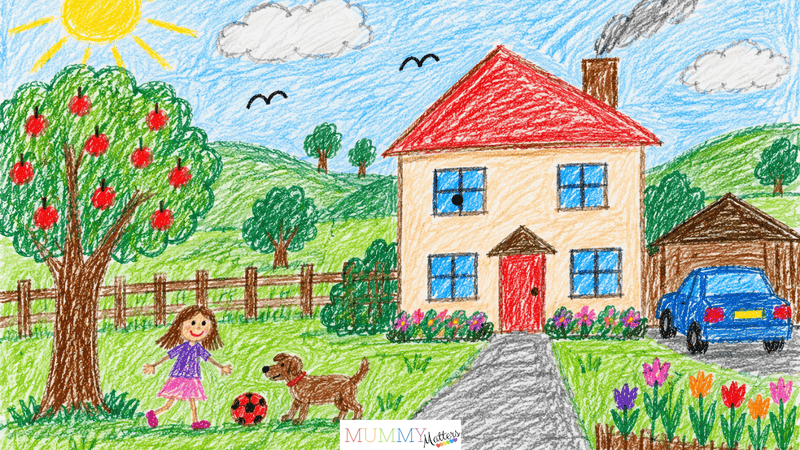
During the dawning realism stage, children may become increasingly interested in making their drawings resemble the world around them. They often begin noticing details that they previously overlooked, such as the proportions of people’s bodies, the shapes of buildings and how objects appear in relation to one another.
This stage is traditionally associated with approximately nine to twelve years of age. However, these age ranges are general descriptions from artistic development theory rather than developmental milestones that every child is expected to reach.
What Do Drawings Look Like During the Dawning Realism Stage?
Some characteristics associated with this stage include:
- Greater attention to detail: Children may add more realistic features to people, animals, buildings and landscapes.
- More awareness of proportions: They might begin noticing when objects appear too large or small in relation to one another.
- Experimenting with space: Drawings may show objects overlapping or positioned at different distances.
- More individual expression: Children may develop preferences for particular subjects, techniques or artistic styles.
- Greater self-awareness: Some children become more critical of their drawings when they don’t match what they intended to create.
Not every child will demonstrate these characteristics, and artistic interests and opportunities to practise can make a considerable difference.
How Parents Can Support Drawing at This Stage
Children who enjoy drawing may appreciate opportunities to explore new techniques without feeling pressured to produce realistic artwork.
You could try:
- Drawing from observation: Encourage your child to sketch a favourite object, pet or view from a window.
- Exploring different materials: Introduce watercolours, charcoal, coloured pencils or digital drawing tools.
- Creating comics or illustrated stories: This allows children to combine drawing with imagination and storytelling.
- Looking at different artistic styles: Explore illustrations, cartoons, abstract art and realistic drawings to show that creativity takes many forms.
- Encouraging persistence: If your child becomes frustrated, remind them that drawing skills can develop with practice and experimentation.
Some children may become less interested in drawing as they grow older, particularly if they feel their pictures aren’t good enough. Encouragement and opportunities to explore different creative activities can help them enjoy art without worrying about perfection. For more inspiration, discover our reasons to encourage budding artists.
The Pseudo-Naturalistic Stage of Drawing (Approximately 12–14 Years)

The pseudo-naturalistic stage is a term used in traditional theories of children’s artistic development to describe a period when young people may become increasingly interested in making their drawings look realistic. It is commonly associated with approximately 12 to 14 years of age, although artistic development doesn’t follow a fixed timetable.
During this stage, some young people begin paying closer attention to proportions, perspective, shading and the way objects appear in real life. They might experiment with drawing faces more accurately, creating three-dimensional effects or showing how light and shadow change the appearance of objects.
It’s also common for young people to become more critical of their artwork as they compare their drawings with what they can see or imagine. Encouragement, opportunities to experiment and reassurance that drawing is a skill developed through practice can help them continue enjoying creative activities.
Not every child will follow these artistic stages in the same way. Drawing ability is influenced by interest, experience and opportunities to practise, and it should not be used on its own to judge a young person’s wider development.
What Do Drawings Look Like During the Pseudo-Naturalistic Stage?
Young people who are interested in developing their artistic skills may begin experimenting with more realistic techniques.
Some examples include:
- More accurate proportions: Drawing people with greater attention to the relative sizes of their heads, bodies, arms and legs.
- Perspective and depth: Experimenting with ways to make objects appear closer or further away.
- Light and shadow: Using shading to create the appearance of three-dimensional shapes.
- Facial expressions: Adding details to communicate emotions or make portraits look more lifelike.
- Personal artistic interests: Exploring subjects such as portraits, landscapes, cartoons, fashion illustration or digital art.
These are possible characteristics of this artistic stage, not skills that every 12- to 14-year-old is expected to demonstrate.
Final Thoughts: Every Child’s Drawing Journey Is Different
Watching children’s drawings change as they grow can be a wonderful experience. From their earliest scribbles to recognisable people, imaginative scenes and more detailed artwork, each stage offers opportunities for creativity, experimentation and self-expression.
The traditional stages of drawing development can help parents understand some of the changes they might notice, but they aren’t a checklist of milestones. Children develop artistic skills at different rates, and their interests, experiences and opportunities to practise all play a part.
The most valuable thing parents can do is provide opportunities to explore different materials, show an interest in their child’s creations and make drawing an enjoyable activity rather than a test of ability.
Whether your child loves filling pages with colourful pictures or would rather build, paint or create in other ways, there’s no single right way to be creative.
If you have concerns about your child’s fine motor skills or wider development, your health visitor, GP or school can offer guidance and help you decide whether further support might be useful.
Updated: October 2026